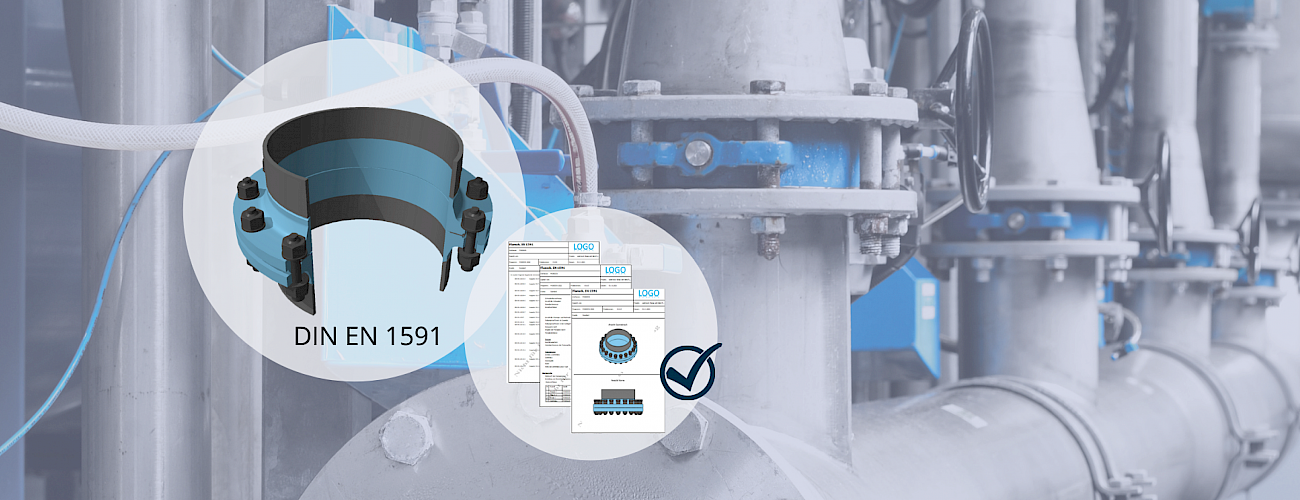
Flange connections according to DIN EN 1591
The safe sealing of machines and systems is a particular challenge for engineers. When it comes to the unwanted escape of liquids or gases from machines, the calculations and verifications are of crucial importance.
A flange-gasket-bolt assembly must be designed to be both technically safe and as cost-effective as possible. In addition, the flange connection must meet all requirements under all operating conditions. The safety requirements are specified in accordance with the European Pressure Equipment Directive (PED) 2014/68/EU and TA-Luft compliance.
The calculation of flange connections in accordance with DIN EN 1591 is a key component in ensuring tightness and strength.
Comparison: DIN EN 1591-1:2014 vs. 2026
Under the new edition of DIN EN 1591, identical input parameters can lead to significantly different results.
The following comparison shows a flange calculation using exactly the same boundary conditions, one based on DIN EN 1591-1:2014 and the other on the current 2026 edition.
Particularly noticeable are the differences in load levels and in the assessment of strength.
While the connection was deemed adequate under the previous standard, the calculation according to DIN EN 1591-1:2026 yields a more critical assessment.
In this example, structural integrity is no longer fully guaranteed under the new valuation methods.
This means that structures previously considered safe may need to be reevaluated.
DIN EN 1591-1:2026 – What has changed?
With the publication of DIN EN 1591-1:2026, a revised edition of the existing standard for the design of flanged joints is now available.
This is not an entirely new standard, but rather a targeted revision of the DIN EN 1591-1:2014 version, aimed at correcting known weaknesses and inaccuracies.
The calculation method remains essentially the same.
However, the results may differ significantly.
The main differences between the previous standard and the current one can be summarized as follows:
| Topic | DIN EN 1591-1:2014 | DIN EN 1591-1:2026 | impact |
|---|---|---|---|
| Sealing performance | Modeling Using Deflection + PQR | Just the PQR factor | More consistent, standardized behavior |
| Lever arms & load ratio | Equations that are partially inaccurate | Revised calculation methods | More realistic stress distribution |
| Limit values for load ratio | Less restrictive | Stricter limits | Greater protection against overuse |
| Screw assembly | Simplified view | Statistical consideration of the preload force | A more realistic assessment |
| Bolt-load test | Indirectly | Explicitly permitted (Annex F) | Direct assessment of actual installation crews |
| Material Properties & Coefficients of Friction | Older data | Updated parameters | More accurate calculation results |
Important:
The original calculations were correct, but were based on models that have since been revised.
Secure and time-saving calculation
With MDESIGN , the flange connection MDESIGN designed for the main load-bearing connection in accordance with the DGRL and the tightness and strength criteria specified in EN 1591-1.
In this context, the entire flange-gasket-bolt connection system is generally considered, with the aim of both Design the structural integrity of Design and verifying its leak-tightness.
The current standard DIN EN 1591-1:2026 has already been fully implemented in MDESIGN .
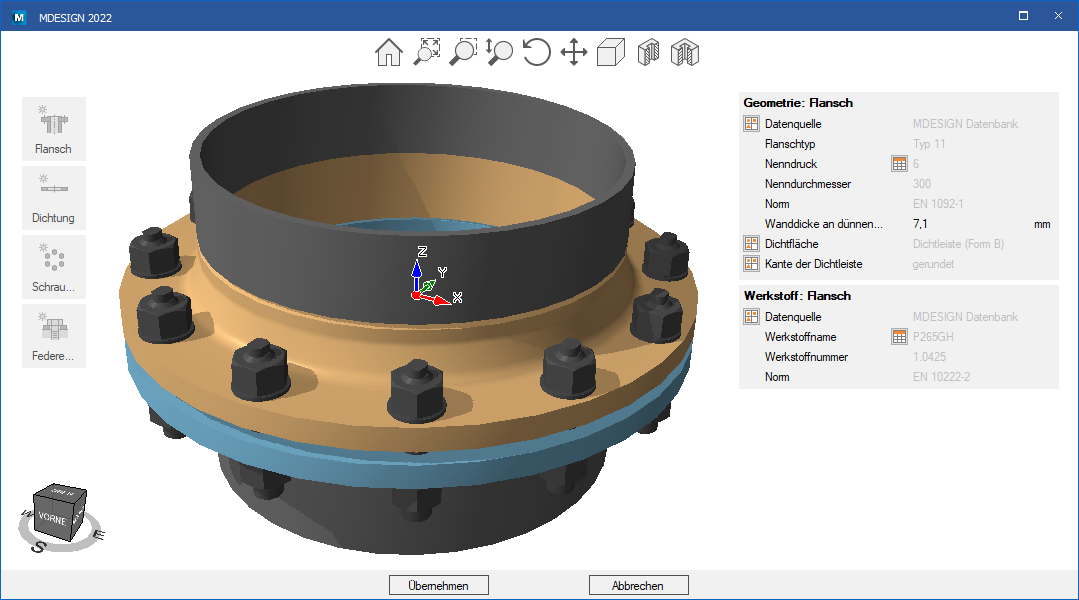
Create a flange connection in a 3D model in just a few seconds
In MDESIGN , different flange types can be selected and configured graphically. This significantly simplifies the design of flange-gasket-bolt assemblies and supports standard-compliant calculations in accordance with DIN EN 1591.
In addition to custom flange geometries, standardized designs compliant with EN 1092-1 or ASME are selected from the MDESIGN , along with all necessary data.
All necessary geometric data and parameters are immediately available.
Visualization and direct data exchange
All relevant results and notes are clearly presented and directly compared with the respective boundary conditions. Project- and task-specific changes are immediately calculated and reflected in the results.
The generated 3D models can be imported directly into common CAD systems via the STEP interface. This eliminates the need for duplicate data entry and makes the entire development process significantly more efficient.
A look at the documentation
Frequently Asked Questions About DIN EN 1591
What is DIN EN 1591-1?
DIN EN 1591-1 is a European standard for the design of flanged joints. It takes into account both the tightness and the strength of the joint under various operating conditions.
What has changed in DIN EN 1591-1:2026?
The current edition includes revised calculation methods, particularly regarding the modeling of sealing behavior, the calculation of lever arms, and the limit values for load ratios. The goal is to provide a more realistic and reliable assessment of flange connections.
Why do the results differ from those of the 2014 version?
Because known inaccuracies and error-prone modeling approaches have been corrected in version 2026. As a result, identical inputs may lead to different results.
Are calculations based on DIN EN 1591-1:2014 still valid?
Formally, yes. However, they are based on older calculation models. A review in accordance with the current standard is recommended, as the safety assessment may have changed.
Do I need to recalculate existing flange connections?
In many cases, a review is advisable, especially for safety-critical applications or if the original design is based on the 2014 version.
How can I verify that my flange connection complies with the current standard?
Using appropriate calculation software such as MDESIGN , existing connections MDESIGN be re-evaluated in accordance with DIN EN 1591-1:2026 and compared with previous results.
What are the benefits of the new standard?
The revised standard allows for a more realistic assessment of loads, better consideration of installation conditions, and, overall, greater safety in the design of flange connections.
How quickly can I perform a flange calculation?
With modern software solutions such as MDESIGN , flange connections MDESIGN be modeled, analyzed, and documented in just a few minutes, taking into account the current standard.