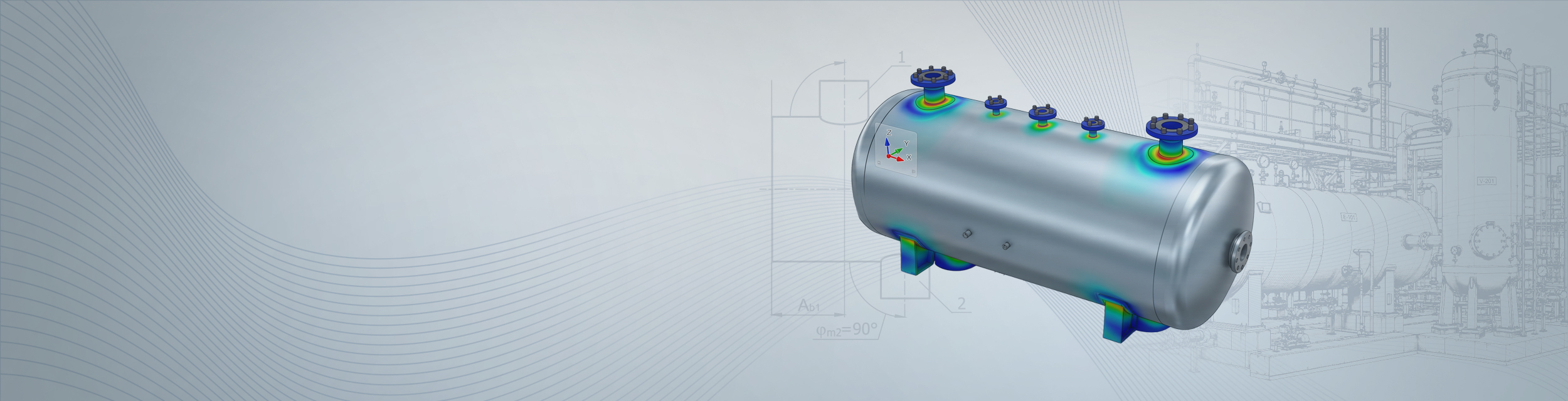
Pressure vessel calculation for
enhanced safety under real-world loads
Identify critical conditions before they affect design
Pressure vessels are among the safety-critical components in plant and equipment engineering. Internal pressure, temperature, external loads, and complex geometries place high demands on design and the verification process.
MDESIGN espresso allows you to calculate, evaluate, and document pressure vessels in accordance with AD 2000 and EN 13445 standards—from wall thickness calculations to a complete verification of the vessel components.
Applicable regulations and guidelines for pressure vessels
AD Policy
A.D. 2000
Non-fired pressure vessels
DIN EN 13445
EU Compliance
Directive 2014/68/EU
Establish standards, accelerate engineering
MDESIGN provides a consistent basis for calculations across the entire team. Structured data entry, centrally maintained calculation bases, and consistent documentation ensure that results remain traceable and comparable across projects.
For over 40 years, MDESIGN has been helping companies calculate and design technical components—today with more than 35,000 users worldwide.

Precisely cetermining wall thickness and strength
The required material thickness is determined by the interplay of pressure, geometry, material, temperature, and safety factors. MDESIGN evaluates these factors for various vessel components and performs strength and stability analyses directly. This makes it clear early on which areas are critical, where there are material reserves, and where design improvements should be made.
Link container components directly to one another
A pressure vessel is not simply a shell. Bottoms, nozzles, cutouts, and reinforcements alter the stress distribution locally and must be designed to be compatible with the overall system.
This means that individual components cannot be viewed in isolation, but must be examined within their structural context. This facilitates coordination between the components and reduces the need for subsequent adjustments when geometries or connection areas change.
Compare operating and test pressures side by side
Installation, operation, and testing place different demands on the same design. Operating pressure, test pressure, temperature, external pressure, and additional loads can cause different areas to become the critical point of the design.
MDESIGN illustrates how normal operation, pressure testing, or a specific load case determines the design parameters. This allows designers to safely and precisely tailor the pressure vessel to meet the requirements.
Translate calculation results directly into design actions
|
01
Guided input, clear results
The interface clearly organizes inputs and results. Wall thicknesses, stresses, loads, and safety verifications are presented in a structured manner, allowing relevant values to be quickly identified and categorized for further design .
|
02
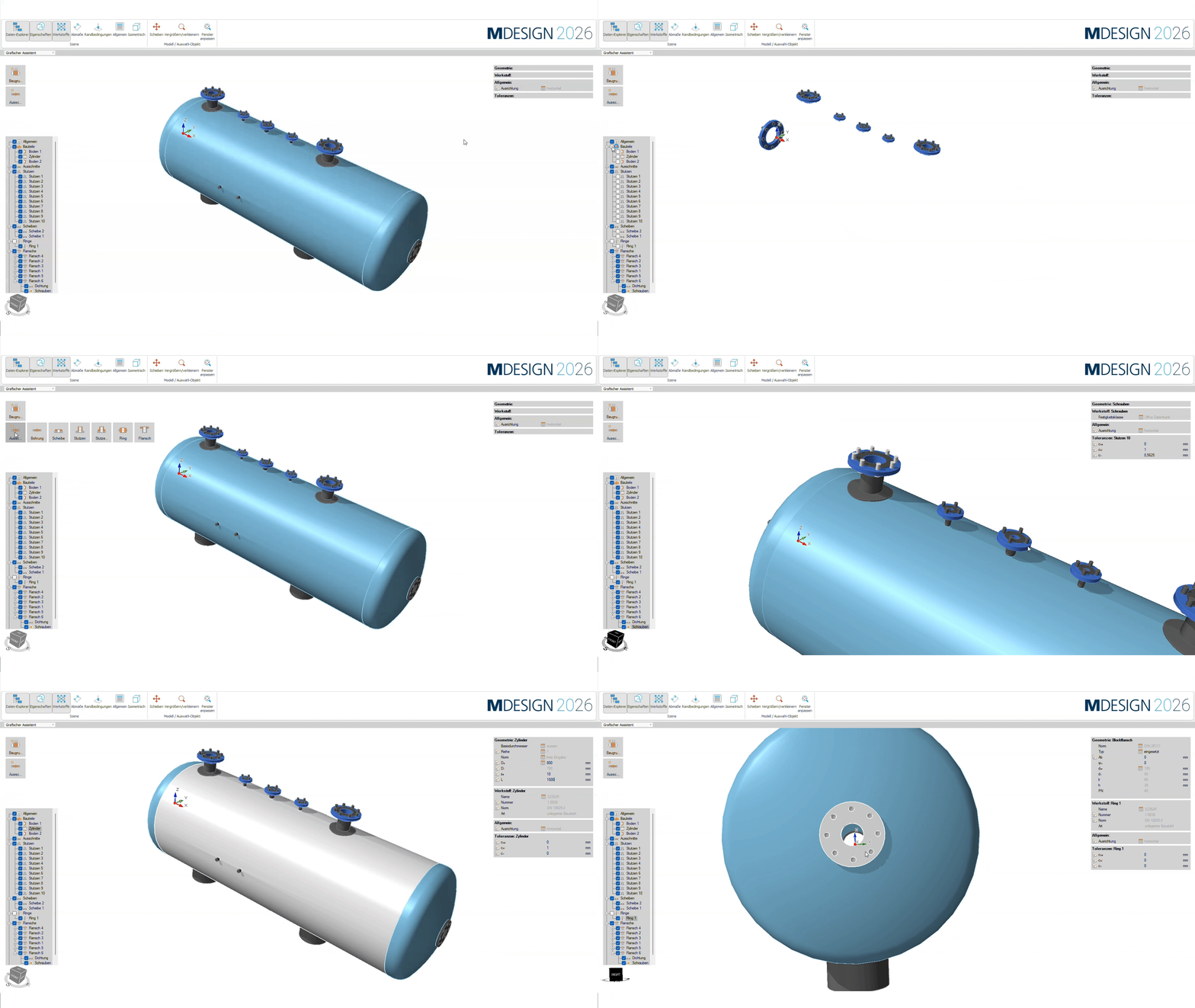
Intuitive 3D modeling
The integrated 3D configurator supports model creation as well as the visualization of loads and vessel components directly within the calculation. This facilitates coordination between the calculation and design for complex vessels.
|
Documentation and proof at the touch of a button
Automatically generate technical documentation.
All input data, standards, boundary conditions, results, and graphics are automatically compiled into a complete set of documentation. This results in transparent verification documentation for internal development, customers, testing organizations, or manufacture.
STEP export directly from the calculation
Components are modeled, analyzed, and evaluated in MDESIGN. The validated results can then be exported directly as STEP files and transferred to CAD systems. This ensures that the entire development process remains consistent—without any data discontinuities or the need for manual geometry transfer.




Features of the MDESIGN pressure vessel calculation
The functions are organized by calculation principles, load data, basic elements, attached elements, cutouts, flanges, material data, and results.
-
Calculation bases & standards
- EN 13445
- A.D. 2000
- Directive 2014/68/EU
-
Load data
Input values
- Internal pressure
- External pressure
- Operating temperature
- Internal test pressure
- External test pressure
- Test temperature
Output values
- Internal calculation pressure
- Calculation temperature
- Maximum allowable operating pressure
- Maximum allowable test pressure
-
Basic elements
Input values
- Series of cylinder shells
- Base diameter
- Specifying the Volume
- Cylinder shell
- Klöpper bottom
- Basket-arch floor
- Hemispherical bottom
- Flat floors
- Outer diameter
- Inner diameter
- Nominal wall thickness
- Length
- Corrosion surcharge
- Negative tolerance on the thickness of the component
Output values
- Required wall thickness
- Calculated wall thickness
- Existing voltage
- Rated calculation voltage
- Safety factor
- Maximum allowable internal pressure
- Maximum allowable external pressure
- Internal volume
- External volume
- Mass
-
Add-on components
Input values
- Position
- Nipple
- Slice
- Ring
- Flange
- Type
- Standard
- Series
- Outer diameter
- Inner diameter
- Wall thickness
- Length
- Angle of inclination
- Distance
- Polar angle
Output values
- Nozzle geometry
- Geometry of discs
- Geometric rings
- Assembly flange
- Tolerances and deviations
- Surcharges and deviations
- Collision check
-
Cutouts & reinforcements
Input values
- Individual ports on cylinders
- Single outlets on arched floors
- Opening with disc-shaped reinforcement
- Opening with ring-shaped reinforcement
- Bracing
- Positioning
- List of excerpts
- Web Geometry
Output values
- Reinforcement area
- Pressure-loaded surface
- Maximum allowable internal pressure
- Verification of the reinforcement between adjacent cutouts
- Web test
- Mutual Influence Between Clips
-
Flange
Input values
- Type
- Rated pressure
- Nominal diameter
- Sealing surface
- Seal type
- Seal material
- Screw material
- Screw type
Output values
- Screw force
- Sealing force
- Sealing surface pressure
- Existing voltage installation
- Actual operating stress
- Check existing stress
- Safety factor for flanges
- Safety factor for screws
- Safety factor against leakage
-
Material data
- Data source MDESIGN database
- Material name
- Material number
- Material standard
- Material type
- Product form
- Heat treatment
- Group
- Steel grade
- Tensile strength
- 0.2 % yield strength
- Elongation at break
- Modulus of elasticity
- Density
- Transverse contraction index
- Temperature-dependent material properties
- Custom material
-
Results & analyses
- Total length
- Total volume
- Total weight
- Internal calculation pressure
- Calculation temperature
- Required wall thickness
- Existing voltage
- Maximum allowable internal pressure
- Maximum allowable external pressure
- List of excerpts
- Web test
- Load factor
- Leak-proof guaranteed
- Strength guaranteed
- Notes
- Graphical visualization of the calculation results
Try it for free – Your access to MDESIGN
Discover for free
Learn about the features
Just get started
No download, no installation
Full range of services
14 days of access to all sections