Belt and chain drives for
flexible power transmission
Design drives to match power, geometry, and operating conditions
For many designs, gear drives are not feasible or economically viable. As an alternative, timing belts, V-belts, and chain drives perform numerous tasks related to power and motion transmission.
MDESIGN Supports the standard-compliant design of a wide variety of belt and chain drives—from simple two-pulley drives to complex multi-shaft and multi-pulley systems.
Standards Considered for Belt and Chain Drives
Narrow V-belts
DIN 2211 & DIN 7753
Standard V-belts
DIN 2215 & DIN 2217
Roller Chain Drives
DIN ISO 10823
Chains & Sprockets
ISO 606
Establish Standards, accelerate Engineering
MDESIGN provides a consistent basis for calculations across the entire team. Structured data entry, centrally maintained calculation bases, and consistent documentation ensure that results remain traceable and comparable across projects.
For over 40 years, MDESIGN has been helping companies calculate and design technical components—today with more than 35,000 users worldwide.

Calculate Belt Length, Tension, and Load
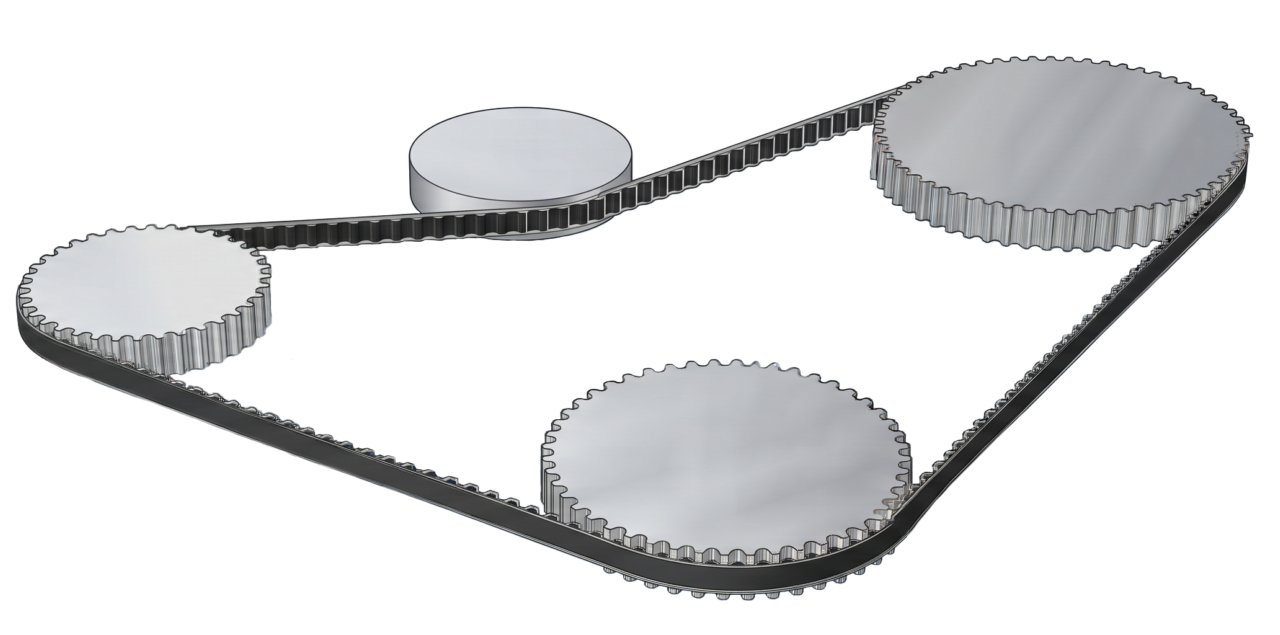
Toothed belts and V-belts offer various options for power transmission, gear ratios, and shaft arrangements. The geometry can quickly become complex, especially when multiple pulleys or tensioners are involved. MDESIGN supports both classic two-pulley drives and toothed belt systems with multiple Shafts, tensioners, and tensioning pulleys. Positions, number of teeth, diameters, and loads can be specified to match the Design . This allows even more complex belt routing to be checked for feasibility at an early stage. Belt length, wrap count, and pretension do not need to be estimated separately but are determined by the configured system.
Selecting Roller Chains Based on Power and Application
For chain drives, power, speed, number of teeth, and operating conditions determine which chain type and size is appropriate. The number of links, center distance, and lubrication also play an important role in the practical design.
For roller chains, you can determine the appropriate chain types, number of strands, pitch, chain length, and load capacity. European and American designs, as well as simplex, duplex, and triplex chains, are included in the calculation range.
This makes it possible to verify, even during the Design , whether the selected chain is sufficiently robust and what type of lubrication is recommended for the intended application.
Belt Drives
Chain Drives
Incorporate operating conditions into the design
Shock loads, varying loads, temperature, and lubrication can significantly alter the stress on a belt or chain drive. A drive that is adequately sized for rated conditions may require different safety margins under actual operating conditions.
Operating factors, preload, dynamic loads, and lubrication conditions are therefore taken into account in the design, depending on the specific calculation scenario. For chains, the lubrication method and viscosity class can also be specified.
This allows for sizing that more closely matches actual operating conditions and reduces the risk of selecting a drive solution that is either too small or unnecessarily large.
Understanding Results and Further Developing Propulsion Concepts
Belt length, chain size, pretension, speed, load capacity, and shaft load indicate whether the selected design is suitable for the application.
Constructive changes can be derived from the results: adjusting pulley sizes, changing center distances, selecting a different belt width, adding additional chain strands, or repositioning tension rollers.
This allows drive concepts to be compared more quickly and assessed early on for their technical feasibility.
|
01
Guided Input and Results Overview
Structured input fields, help texts, and technical notes provide guidance on geometry, loading, gear ratios, and prestressing. An integrated AI assistant helps answer questions during the calculation. The most important parameters and results are clearly presented.
|
02
Understanding the Drive System in a 3D Model
Pulleys, sprockets, tension rollers, and cable routes are displayed in the 3D model. This makes it easier to understand center distances, positions, and geometric relationships and to compare them with the planned Design .
|
Documentation and proof at the touch of a button
Automatically generate technical documentation.
All input data, standards, boundary conditions, results, and graphics are automatically compiled into a complete set of documentation. This results in transparent verification documentation for internal development, customers, testing organizations, or Manufacture.
Features of MDESIGN Belt and Chain Drives
The functions are organized into compact categories based on standards, V-belts, timing belts, roller chains, and wrap-around configurations.
-
Standards & Calculation Bases
- DIN 2211-1
- DIN 2215
- DIN 2217-1
- DIN 323-1
- DIN 323-2
- DIN 7753-1
- DIN ISO 10823
- ISO 606
- Calculation Based on the Literature
- Catalog data for Walther Flender and the Mulco Group
-
Standard & Narrow V-Belts
Input values
- Max. disc diameter
- Approximate wheelbase
- Application Factor
- Power to be transmitted
- Drive Speed
- Output speed
- Gear Ratio
- Coefficient of friction
Output values
- Belt Profile
- Rated power per belt
- Number of belts required
- Outer length
- Effective length
- Pulleys' rim width
- Effective diameter of the drive pulley
- Effective diameter of the output disc
- Wheelbase
- Axle-to-axle adjustment range for mounting
- Axle-to-axle adjustment range for clamping
- Enveloping angle of the small disk
- Belt speed
- Bending frequency
- Circumferential force
- Dynamic shaft load
-
Toothed belt
Input values
- Belt Type
- Timing Belt Type
- Division
- Automatically Determine Standard Widths
- Direction of rotation
- Type of voltage
- Position along the x-axis
- Position along the y-axis
- Number of teeth on the toothed disc
- Maximum effective diameter of the toothed disc
- Drive pulley
- Tension pulley
- Clamping disc
- Offset angle of the clamping disc
- Performance of the Loaded Toothed Disc
- Torque of the loaded toothed disc
- Circumferential force on the loaded toothed disc
- Rotational speed of the toothed disc
- Load factor
Output values
- Belt Designation
- Belt Pitch
- Selected Default Belt Length
- Number of teeth on the belt
- Selected Default Belt Width
- Required belt length
- Complete Translation
- Safety Considerations Regarding Belt Width
- Circumferential speed
- Required preload force
- Current position along the x-axis
- Current position along the y-axis
- Effective diameter of the toothed disc
- Outer diameter of the toothed disc
- Wheelbase
- Free drum length
- Natural frequency of the freely oscillating drum length
- Enveloping angle at the toothed disc
- Number of teeth in engagement on the toothed disc
- Required belt width
- Total Application Factor
- Test load
-
Roller chain
Input values
- Calculation Mode
- Type of roller chain to be used
- Drive Power
- Drive Speed
- Number of teeth on the drive wheel
- Number of teeth on the output gear
- Approximate wheelbase
- Operating Conditions for a Propulsion Engine
- Operating Conditions for a Driven Machine
- Factor for accounting for operating conditions
- Factor for accounting for the number of teeth on the smaller gear
Output values
- Selected Chain Type
- Number of chain strands
- Chain Pitch
- Number of chain links
- Maximum center-to-center distance
- Chain speed
- Maximum corrected power for a given drive speed
- Chain Load Factor
- Calculated number of links in the chain
- Recommended Lubrication Method
- Viscosity grade of the lubricating oil
-
Encircling
Input values
- Diameter of the small pulley
- Diameter of the large pulley
- Wavelength
- Belt Length
Output values
- Diameter of the small pulley
- Diameter of the large pulley
- Wavelength
- Belt Length
- Translation
- Angle of wrap around the small pulley
- Angle of wrap around the large pulley
- Wrap-around bracket for small pulley
- Wrap-around bracket for large pulley
Try it for free – Your access to MDESIGN
Discover for free
Learn about the features
Just get started
No download, no installation
Full Range of services
14 days of access to all sections