Spring calculation for precise
dimensioning and verification
Greater reliability in terms of travel, tension, and service life
Springs In mechanical engineering, springs play a central role in energy storage, power transmission, and the absorption of motion and load cycles. Depending on the specific application, MDESIGN mechanical supports the design and verification of a wide variety of spring types under static, quasi-static, and dynamic loads.
The integrated material database, which includes numerous spring materials, reduces the effort involved in material selection and provides a consistent basis for all calculations. In addition, users can import their own material properties and company standards into the MDESIGN customer database at any time.
This allows Springs to be tailored more quickly to the specific task and technical limitations to be identified early on.
Establish Standards, accelerate Engineering
MDESIGN provides a consistent basis for calculations across the entire team. Structured data entry, centrally maintained calculation bases, and consistent documentation ensure that results remain traceable and comparable across projects.
For over 40 years, MDESIGN has been helping companies calculate and design technical components—today with more than 35,000 users worldwide.

Early Detection of Critical Stresses and Safety Limits
When designing a helical spring ( Spring ), the geometry and load must be matched so that the required spring force and travel are achieved without exceeding permissible stresses or safety limits. Depending on the spring type,MDESIGN calculates, among other things, spring forces, spring rates, spring travel, stresses, Safeties, spring lengths, number of coils, and natural frequencies. Dynamic loads and fatigue strength analyses can also be taken into account. This makes it clear early on whether a selected geometry fulfills the required function or whether the wire diameter, number of coils, spring length, or other dimensions need to be adjusted. This reduces unnecessary iterations and facilitates targeted dimensioning.
Calculate the appropriate spring types for the application
Depending on the application, requirements for spring force, spring travel, dynamic performance, fatigue strength, and material behavior vary considerably.
MDESIGN It supports the calculation of a wide variety of spring types for a broad range of applications in mechanical and plant engineering. This allows different spring designs to be modeled within the same software environment and evaluated based on the specific load, spring movement, and installation conditions.

Compression Springs

Tension Springs

Disc Springs

Torsion Springs

Torsion bars
Take into account dynamics, temperature, and fatigue strength
Springs They often operate under varying loads and repetitive movements. Dynamic stresses, vibrations, and temperature can affect stress levels, fatigue strength, and spring behavior.
MDESIGN Depending on the type of spring, the calculation takes into account the number of load cycles, vibration loads, natural frequencies, temperature dependencies, as well as the effects of friction and guidance. Material-specific parameters are also incorporated into the calculation.
This allows the " Spring " to be evaluated not only for a single load point, but for the intended operating conditions. Critical stresses can be identified early on, and the geometry or material can be adjusted accordingly.
Understanding Results and Further Developing " Springs " in a Targeted Manner
Spring forces, spring travel, stresses, Safeties , and characteristic curves indicate whether the selected Spring meets the required specifications. Goodman diagrams and other charts assist in evaluating dynamic loads and fatigue strength.
Based on this, wire diameter, number of coils, spring length, preload, and geometry can be adjusted and reevaluated. As a result, the calculation more quickly yields a Spring that effectively balances function, installation space, and load-bearing capacity.
|
01
Guided Input and Results Overview
Quick and reliable entry of various spring geometries, loads, and materials. AI assistants, status indicators, and intelligent input aids support the rapid modeling of a wide variety of spring types.
|

02
Automatically Generated Charts
Spring characteristics, Goodman diagrams, and other graphical representations help in evaluating stresses, fatigue strength, and spring behavior. This makes it possible to identify critical areas more quickly and to better understand technical relationships.
|
Documentation and proof at the touch of a button
Automatically generate technical documentation.
All input data, standards, boundary conditions, results, and graphics are automatically compiled into a complete set of documentation. This results in transparent verification documentation for internal development, customers, testing organizations, or Manufacture.
Features of the " MDESIGN " Spring Calculation
The functions are organized into the following categories: standards, compression springs, tension springs, torsion springs, torsion bar springs, and disc springs.
-
Standards & Calculation Bases
- DIN EN 13906-1
- DIN EN 13906-2
- DIN EN 13906-3
- DIN EN 16983
- DIN EN 16984
- DIN 2091
- DIN 2194
- Calculation Based on the Literature
-
Compression Springs
Input values
- Quality Grades
- Suspension Specifications
- Spring force
- Spring rate
- Suspension travel
- Insurance Claim
- Number of load cycles
- Production Method
- Geometric Specification
- Average coil diameter
- Outer diameter
- Inner diameter
- Mandrel and Sleeve Diameters
- Winding ratio
- Operating temperature
- Design of the terminal turns
- Direction of Winding
- Mounting the Spring Ends
Output values
- Wire diameter
- Number of spring coils
- Total number of turns
- Spring rate
- Spring forces
- Suspension travel
- Spring lengths
- Block Length
- Shear stresses
- Corrected Shear Stresses
- Protection Against Fatigue Failure
- Static Safety Factor
- Bending travel
- Lateral spring rate
- Longitudinal natural frequency
Sample Results Chart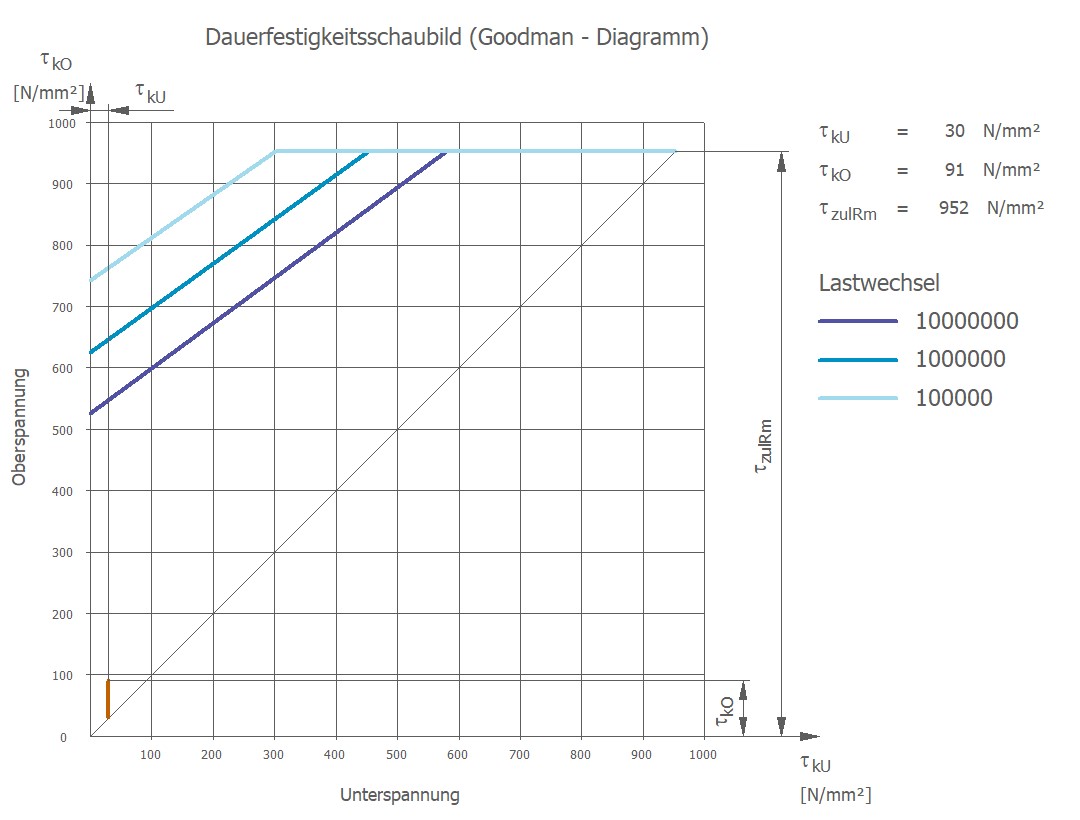
An example of a graphical analysis of a compression spring diagram. -
Tension Springs
Input values
- Quality Grades
- Spring forces
- Suspension travel
- Internal Preload Force
- Production Method
- Type of eyelet
- Insurance Claim
- Load-cycle frequency
- Number of load cycles
- Geometric Specification
- Outer diameter
- Installation length
- Length from the inner edge of the eyelet to the spring body
- Operating temperature
Output values
- Wire diameter
- Spring rate
- Internal Preload Force
- Spring forces
- Suspension travel
- Spring lengths
- Number of spring coils
- Total number of turns
- Permissible shear stress
- Corrected Shear Stresses
- Corrected stroke voltage
- Longitudinal natural frequency
- Wire length
- Mass of the spring wire
Sample Results Chart
An example of a graphical analysis of a tension-spring diagram. -
Torsion Springs
Input values
- Quality Grades
- Spring torque at α1
- Spring torque at α2
- Lifting Rotation Angle
- Direction of Load
- Insurance Claim
- Geometric Specification
- Outer diameter
- Inner diameter
- Winding ratio
- Shape of the spring legs
- Bending Radii
- Side lengths
- Coil Spacing
- Mounting the Spring Legs
- Operating temperature
Output values
- Wire diameter
- Spring torque rate
- Number of spring coils
- Thigh angle
- Spring Torques
- Angle of rotation
- Lift angle
- Spring body length
- Voltage correction factor
- Corrected bending stresses
- Corrected bending stress
- Permissible bending stress
- Suspension work
- Work mandrel diameter
- Working Sleeve Diameter
Sample Results Chart
An example of a graphical analysis of a torsion spring diagram. -
Torsion bars
Input values
- Calculation Run
- Type of Design
- Minimum torque
- Maximum torque
- Spring rate
- Lift angle
- Free torsion bar length
- Rod diameter
- Radius of curvature of the chamfer
- Preface
- Design of the Torsion Bar Heads
- Operating temperature
- Safety Against Shear Stress
Output values
- Rod diameter
- Spring Length
- Clamping head length
- Spring rate
- Angle of twist
- Lift angle
- Torques
- Suspension work
- Surface compression at the torsion bar head
- Shear stresses
- Continuous-load capacity
- Safety Against Shear Stress
- Protection Against Lift Voltage
Sample Results Chart
An example of a graphical analysis of a Smith chart. -
Disc Springs
Input values
- Calculation Run
- Preload force
- Load
- Minimum spring travel
- Maximum spring travel
- Maximum installation length
- Maximum number of Springs per spring assembly
- Preferred Series
- Minimum outer diameter
- Maximum outer diameter
- Minimum inner diameter
- Maximum inner diameter
- Insurance Claim
- Load cycle count
- Operating temperature
Output values
- Name of the disc spring
- Disc spring thickness
- Maximum suspension travel
- Overall Management Game
- Number of individual springs per spring assembly
- Number of spring assemblies
- Total number of individual springs
- Overall Height of the Disc Spring Column
- Spring forces
- Suspension travel
- Spring Rates
- Suspension work
- Efficiency
- Tensions
- Protection Against Violent Breakage
- Safety against permanent failure
Sample Results Chart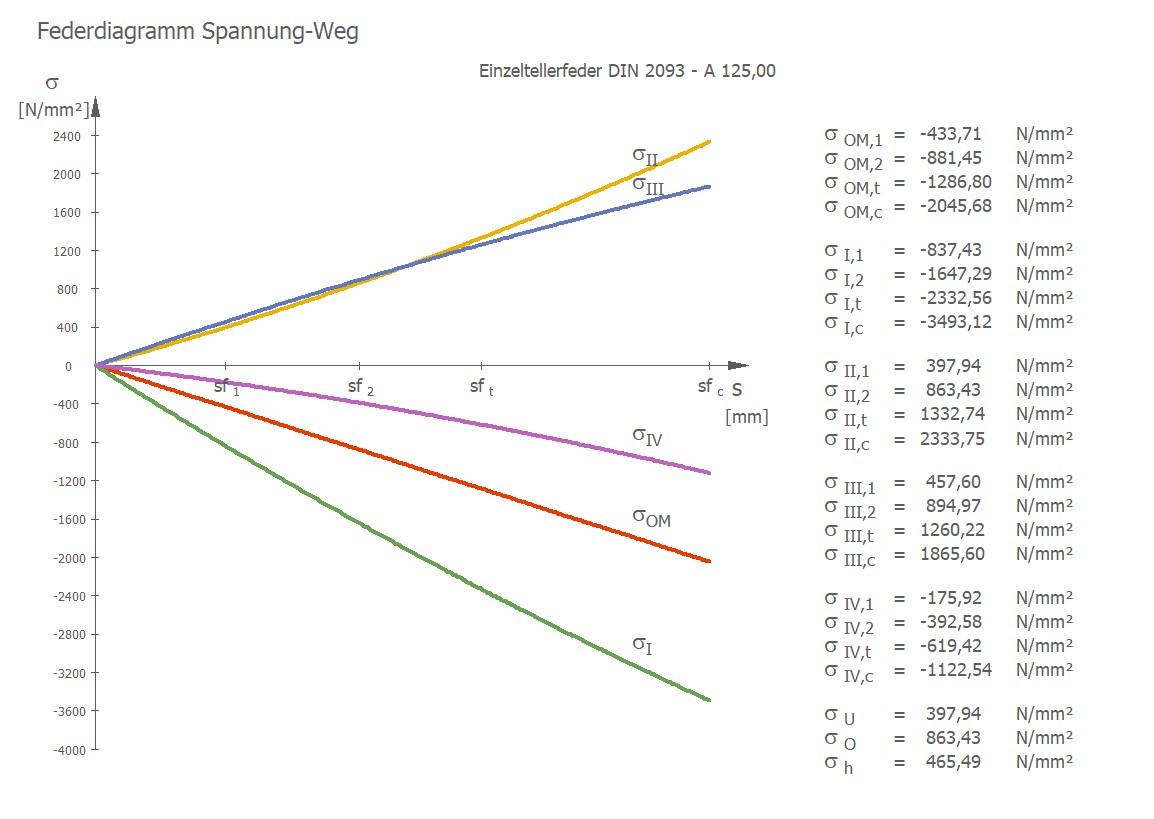
An example of a graphical analysis of a spring diagram for a disc spring.
Try it for free – Your access to MDESIGN
Discover for free
Learn about the features
Just get started
No download, no installation
Full Range of services
14 days of access to all sections