Seminar
A New Approach to Spring Calculations
: New Perspectives from the FKM Guideline
Do you need to design a technical Spring and want to ensure
that it meets the requirements? The new FKM guideline for Springs and
spring elements enables a customized fatigue strength analysis—
based on geometry, material, manufacturing, and loading.
It thus offers a traceable and reliable alternative to
conventional design using Goodman diagrams.
This seminar is independent of the MDESIGN.
It is not necessary to install or use the software.
Here are the topics you can expect…


Seminar – Preview
Contents & details
 Fundamentals of fatigue strength &
Factors Affecting the Fatigue Strength of Springs
- Loads, stresses, tensions
- Spring types and their stresses
- Existing stresses in general and in spring elements
- Influences on the bearable stress amplitude
(material characteristics, microstructure, chem. composition, component geometry, surface roughness, residual stresses, mean stress, number of cycles) - Principle of local fatigue strength
- Fatigue strength diagrams (Goodman diagram, Haigh diagram)
- Basics of damage accumulation calculation
 Example helical compression spring
- Shear stresses
- General Procedure for the FKM Guideline " Springs " (Shear Stresses)
- Calculation of the existing stresses according to EN13906-1 under
- Consideration of permissible deviations according to DIN 15800 and EN 10270
- Explanation of the spring-specific features of a helical compression spring with regard to cyclic strength:
- Material changes due to heat treatment and their consideration
- Support number concept, calculation of the highly stressed surface of a helical compression spring, basics for statistical support number
- Consideration of surface roughness
- Effects of Medium Voltage on the Withstand Voltage Amplitude (Distinction Between Radiated and Non-Radiated Springs, with a Calculation Example)
- Effect of shot peening to increase vibration resistance (taken into account by offset value or principle of medium-voltage displacement)
- Influences of the number of cycles on bearable voltage amplitudes (with calculation example)
- Explanations of the basics of the two-stage safety concept (safety factor for confidence level, safety factor for higher probability of survival)
- Evaluation of the degree of utilization as a result of the calculation process
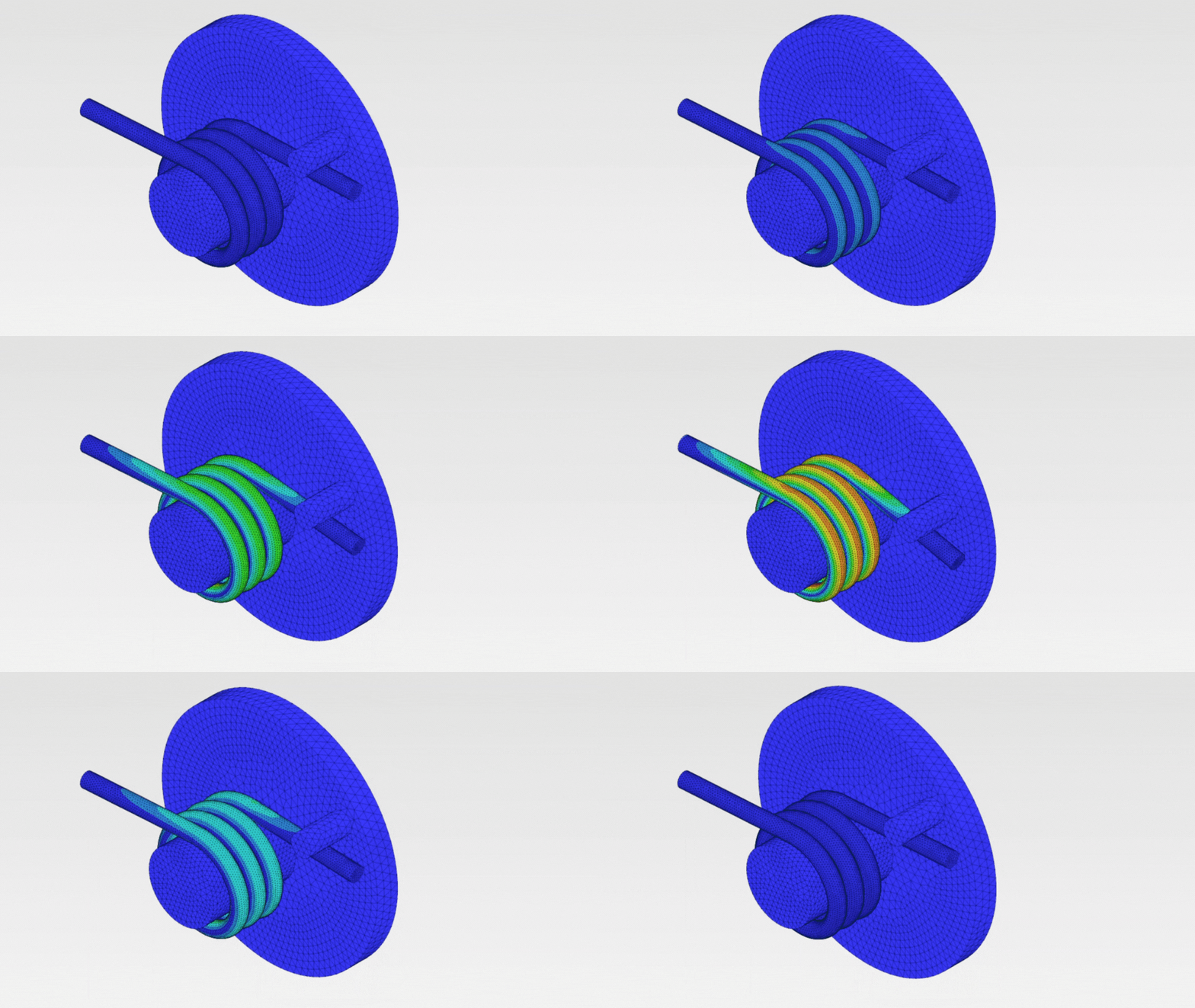
Example of a torsion spring
- Normal stresses
- General Procedure for the FKM Guideline " Springs " (Normal Tensions)
- Calculation of the existing stresses according to EN13906-3 depending on the direction of actuation
- Explanation of the spring-specific features of a torsion spring with regard to cyclic strength
- Observations on fracture-critical areas of a torsion spring
- Support number concept, calculation of the highly stressed surface of a torsion spring, basics for statistical support number
- Further influences are considered based on part 2
- Similar to part 2 with a difference in the type of voltage (normal voltages)
- Differences to the safety concept for helical compression springs
- Evaluation of the degree of utilization as a result of the calculation process
 Spring elements - What to do if a spring element
Is there torsion or bending?
- Calculation of existing stresses, general approaches from technical mechanics
- Definition of the highly stressed surface for estimating the statistical support number
- Calculation of the respective degree of utilization and evaluation
 Procedure for combined synchronous loading
(shear stresses & normal stresses)
- Considerations on various possible paths
- Evaluation of the degree of utilization

Your speaker
Dr.-Ing. René Reich
- Member of the "Wire and Springs " research group at the Technical University of Ilmenau
- Research work at the Steinbeis Transfer Center for Spring Technology
with a focus on the calculation and design of spring systems - Project manager, research assistant and teacher for special tasks
- Seminar leader with many years of experience for leading spring manufacturing companies at home and abroad
- Doctoral dissertation in the field of cyclically loaded Springs
- Mechanical engineering studies at the Technical University of Ilmenau

Target group
Engineers and specialists from the fields of development, Design and calculation.

Dates
September 30 – October 1, 2026:
October 3 – November 4, 2026:
Seminar dates
9:00 a.m. – 1:00 p.m. (German)
9:00 a.m. – 1:00 p.m. (German)
Seminar prices

Take advantage of our customer benefit of 10% as an MDESIGN service customer.
All prices plus VAT.

Seminar request for companies
For a larger number of participants in a company, we also offer our training courses on individual dates.