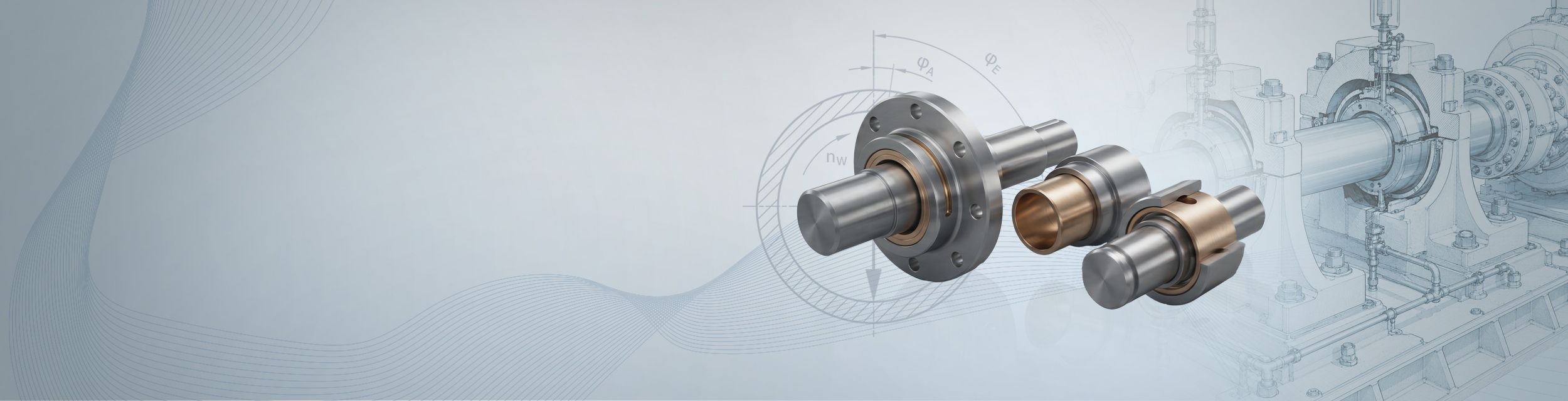
Plain bearing calculation for
real operating conditions
Test Thermal Stability and Load-Bearing Capacity Early On
Plain Bearings They are used wherever high rotational speeds, compact designs, shock loads, or contaminated operating conditions are present. Compared to roller bearings , they offer design advantages in many applications but place higher demands on lubrication, temperature behavior, and operating conditions.
MDESIGN allows you to calculate, evaluate, and document radial and axial sliding bearings in accordance with industry standards—from the initial design through to a detailed analysis of the lubricating film, temperature, and load-carrying capacity.
Standards and guidelines considered for hydrodynamic Plain Bearings
Radial plain bearings
DIN 31652
Axial slide bearing
DIN 31653/31654
Tilting-segment bearing
ISO 12130
Design & Viscosity
VDI 2204 & DIN 51519
Establish Standards, accelerate Engineering
MDESIGN provides a consistent basis for calculations across the entire team. Structured data entry, centrally maintained calculation bases, and consistent documentation ensure that results remain traceable and comparable across projects.
For over 40 years, MDESIGN has been helping companies calculate and design technical components—today with more than 35,000 users worldwide.

Reliably Determining the Operating Limits of Plain Bearings
Load capacity alone is not sufficient for evaluating a sliding bearing. The decisive factor is whether a sufficient lubricating film forms under the intended operating conditions and whether temperature, friction, and specific load remain within permissible limits. Calculations include, among other things, the minimum lubricating film thickness, bearing load, frictional power, lubricant flow rate, operating viscosity, and bearing temperature. Geometry and bearing clearance are taken into account, as are rotational speed and lubricant supply. This makes it possible to determine whether the selected bearing design operates stably or whether adjustments to the geometry, lubrication, or operating conditions are necessary.

Use Your Own and Pre-Stored Lubricant Data
Lubricant data from various manufacturers and ISO viscosity grades are available for the calculation. Custom lubricants and company-specific parameters can be added and saved for future calculations.
An Overview of Different Bearing Designs
Depending on the design, pressure distribution, lubricating film, and heat generation vary significantly. MDESIGN supports radial sliding bearings, axial segment bearings, and axial tilting segment bearings subjected to static loads using the appropriate calculation methods.
In addition to geometry and load, lubrication, bearing clearance, cooling, and temperature conditions can also be taken into account. This makes it possible to evaluate different bearing designs to suit the specific application.
Temperature Behavior Under Real Operating Conditions
Friction generates heat during operation. As the temperature rises, the viscosity of the lubricant often decreases—and this can also alter the load-bearing lubricant film. This cycle must be taken into account to ensure a robust design.
Heat dissipation via the housing, convection, or circulating lubrication can be taken into account, as can the lubricant inlet and outlet temperatures. This results, among other things, in the effective lubricant temperature, frictional heat, and required flow rate.
This allows critical thermal conditions to be detected as early as the " Design " stage. Cooling, lubricant volume, or bearing geometry can be adjusted before elevated temperatures lead to wear, performance losses, or damage.
Results as a Basis for Warehouse Optimization
|
01
Guided Interface and Results Overview
Structured input fields, help texts, and technical notes provide guidance on geometry, loads, lubricants, and operating conditions. An AI assistant helps answer questions during the calculation. Parameters and results are clearly presented for documentation purposes.
|
02
Illustrations and technical drawings
Technical sketches and reference diagrams assist in entering geometry, bearing clearance, lubricant supply, and other boundary conditions. They make it easier to understand the relevant calculation parameters for more complex bearing geometries.
|
Documentation and proof at the touch of a button
Automatically generate technical documentation.
All input data, standards, boundary conditions, results, and graphics are automatically compiled into a complete set of documentation. This results in transparent verification documentation for internal development, customers, testing organizations, or Manufacture.
Features of the MDESIGN Plain Bearing Calculator
The functions are organized concisely into the following categories: standards, radial plain bearings, axial plain bearings, lubricant supply, lubricant specifications, and heat balance.
-
Standards & Calculation Bases
- DIN 31652-1
- DIN 31652-2
- DIN 31652-3
- DIN 31653-1
- DIN 31653-2
- DIN 31653-3
- ISO 12130-1
- ISO 12130-2
- ISO 12130-3
- DIN ISO 3448
- VDI 2204, Part 1
- VDI 2204, Part 2
- VDI 2204, Part 3
- Calculation Based on the Literature
-
Radial plain bearings
Input values
- Nominal diameter
- Load-bearing bearing width
- Method of Entering Bearing Clearance
- Min. Bearing Clearance
- Center Lap Game
- Max. Bearing Clearance
- Bearing Design
- Type of Lubricant Supply
- Lubrication hole diameter
- Storage capacity
- Shaft speed
- Bearing speed
- Lubricant supply pressure
- Type of cooling
- Lubricant inlet temperature
- Minimum permissible lubricating film thickness
- Maximum Allowable Specific Bearing Load
- Maximum Permissible Storage Temperature
Output values
- Minimum clearance height
- Effective lubricating film temperature
- Specific Bearing Load
- Relative bearing width
- Bearing play
- Offset Angle
- Relative Bearing Play
- Relative eccentricity
- Summer field number
- Operating viscosity (dyn.)
- Operating viscosity (kin.)
- Lubricant flow rate
- Friction power
- Evaluation of the Calculation Results
-
Axial slide bearing
Input values
- Basis for Calculation
- Outer diameter of the support ring / across the tilting segments
- Inner diameter of the support ring / across the tilting segments
- Segment length / Length of a tilting segment
- Number of segments / Tilting segments
- Relative distance between the reference point and the inlet of the gap
- Heat-emitting housing surface
- Ambient temperature
- Lubricant temperature at the bearing inlet
- Lubricant temperature at the bearing outlet
- Bearing Power During Operation
- Bearing Load Capacity When Idle
- Rotational speed
- Maximum Allowable Specific Bearing Load
- Maximum Permissible Storage Temperature
- Minimum Permissible Lubricating Film Thickness
- External Heat Transfer Coefficient
- Mixing factor
- Critical Reynolds number
Output values
- Average sliding diameter
- Segment Width / Tilting Segment Width
- Sliding speed
- Specific Bearing Load During Operation
- Dimensionless Load-Carrying Capacity Index
- Coefficient of Friction
- Groove depth
- Storage Temperature with Heat Dissipation by Convection
- Effective Lubricant Temperature in Circulating Lubrication Systems
- Minimum lubricating film thickness
- Friction power
- Lubricant flow rate of the bearing
- Reynolds number
- Evaluation of Results
-
Lubricant Supply
- Grease fitting
- Grease nut
- Lubrication bag
- Lubricant supply pressure
- Lubricant flow rate resulting from internal pressure buildup
- Lubricant flow rate due to lubricant supply pressure
- Lubricant flow rate at the inlet gap
- Lubricant flow rate at the outlet gap
- Lubricant flow at the edges
- Lubricant flow rate of the bearing
-
Lubricant & Viscosity
- ISO VG Viscosity Class
- Kinematic oil viscosity
- Dynamic viscosity of the lubricant
- Density of the lubricant
- Specific heat capacity of the lubricant
- Operating viscosity (dyn.)
- Operating viscosity (kin.)
- Lubricant temperature at the bearing inlet
- Lubricant temperature at the bearing outlet
- Effective lubricant temperature
-
Heat Balance & Cooling
- Heat-emitting housing surface
- Heat Transfer Coefficient
- External Heat Transfer Coefficient
- Heat Flow Due to Convection
- Heat flux through the lubricant
- Storage Temperature with Heat Dissipation by Convection
- Effective Lubricant Temperature in Circulating Lubrication Systems
- Temperature Increase in the Lubrication Gap
- Increase in lubricant temperature after the mixing process
- Friction power
Try it for free – Your access to MDESIGN
Discover for free
Learn about the features
Just get started
No download, no installation
Full Range of services
14 days of access to all sections