

Technical documentation - the basis for safe and comprehensible designs
Increasing quality requirements and stricter specifications from inspection authorities and customers are increasing the importance of technical documentation in mechanical and plant engineering.
Complete documentation is required by law at the latest when a machine is placed on the market for the first time.
In Europe, the EC Machinery Directive 2006/42/EC regulates the safety and health requirements, in Germany they are implemented by the Product Safety Act (ProdSG).
According to these specifications, technical documents must contain design and calculation verifications. In other words, complete information on the design, application and calculation principles of a machine.
If this evidence is missing or incomplete, commissioning may be prohibited.
Liability and penalty risks are also possible. A risk that can be avoided with structured and verifiable documentation.
More than just an obligation - documentation as part of technical responsibility
Technical documentation is not just a legal requirement, but an integral part of responsible engineering work.
It describes how technical decisions were made, what standards and assumptions they are based on and what safety margins were used.
Especially in Design , it creates traceability and trust. Within the company, with customers and with inspection bodies.
Complete documentation includes calculations, design drawings, material data, load assumptions and test reports.
It forms the technical memory of a product and therefore the basis for maintenance, further development and product safety.

"Documentation doesn't mean effort, it means responsibility. It records what we as engineers have created."
Optimization of work processes through documentation
Well-structured documentation not only improves verification, but also internal processes.
In many companies today, project teams are international and dynamic. In the event of absences or personnel changes, centrally maintained documentation can ensure the progress of work.
If calculation data, boundary conditions and results are stored centrally and can be viewed by everyone involved, interruptions in the project can be compensated for more quickly.
Digital systems help to secure knowledge and standardize processes.
In the long term, this saves time, costs and reduces sources of error.
When knowledge is in Excel - risks of individual documentation
Many engineering teams still document their calculations manually or with their own Excel tools.
What seems practical in everyday life leads to problems in the long term:
-
Lack of standardization: Every person documents differently - this makes traceability and comparability difficult.
-
Increased susceptibility to errors: Manual input, unprotected formulas and versioning problems are common causes.
-
Loss of knowledge: When the creator of the file retires, there is often a lack of understanding of the structure and calculation logic.
Who should then maintain or expand the file?
And above all: Where is technical knowledge stored permanently?
Knowledge is the basis of any further development - and ultimately also the basis on which artificial intelligence can learn.
However, without structured documentation, this knowledge remains hidden in silos and therefore inaccessible for future systems.
Matching technical article: MDESIGN vs. Microsoft Excel - a comparison
From the calculation model to the verification report
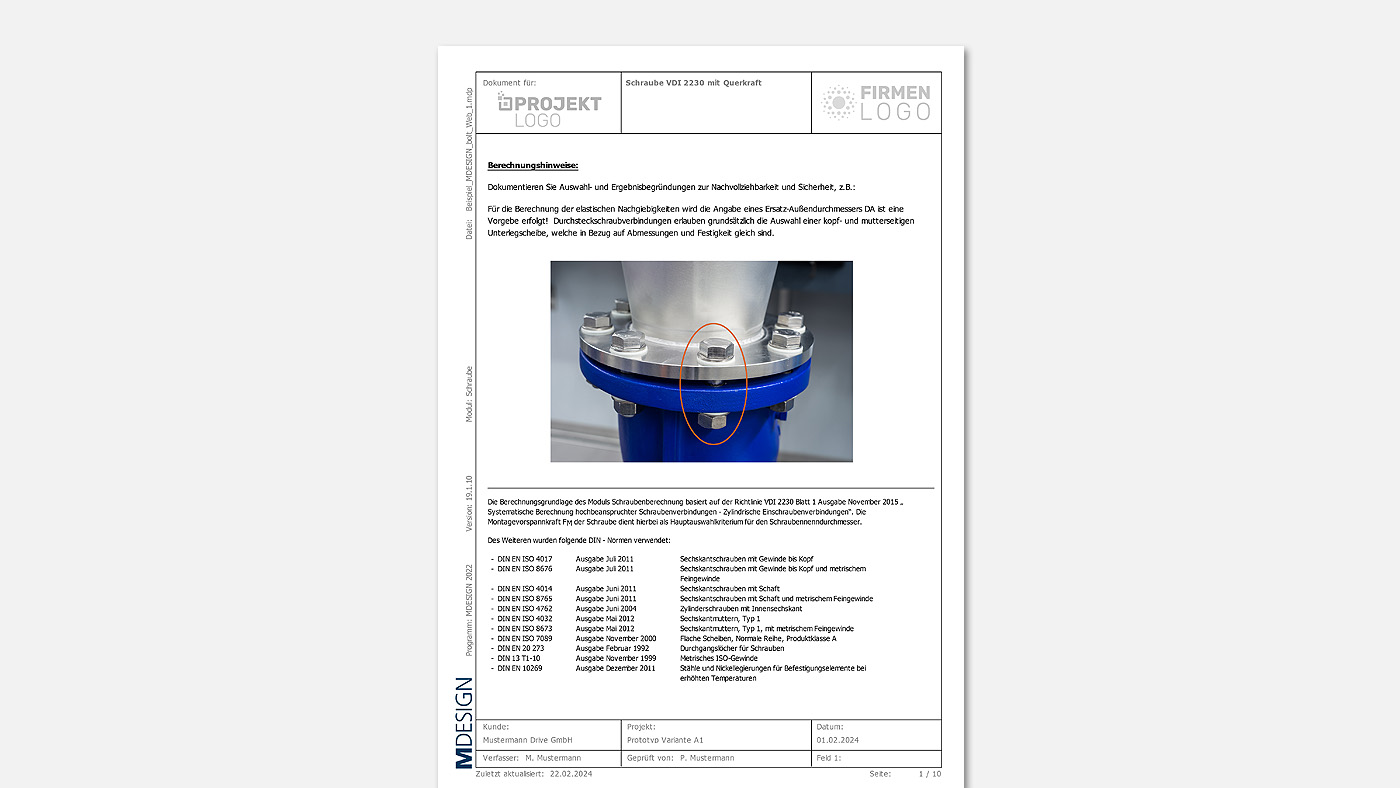
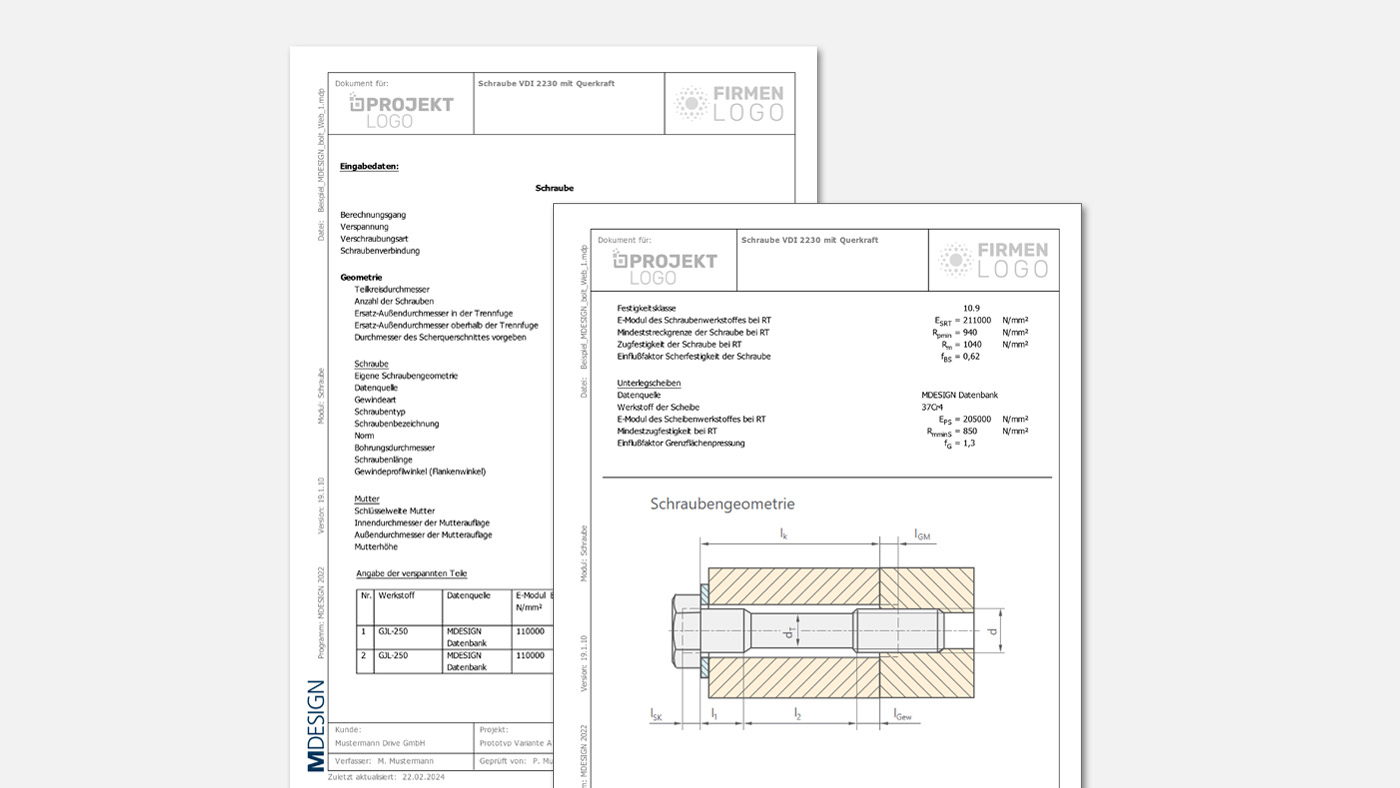
Modern development processes integrate the documentation directly into the calculation environment.
Inputs, standard references, formulas and results are automatically merged without additional effort for the designers.
The result is complete, auditable and multilingual documentation that can be passed on directly to customers or inspection authorities.
The ability to flexibly adapt the layout, scope and language ensures that the documentation can be used optimally both internally and externally.
The generated certificates can be output directly as PDF files in ISO-compliant PDF/A-1a format. This format is specially designed for the long-term archiving of technical documents and meets the requirements of many inspection authorities for unalterable certificates.
Read the technical article to find out how documentation can be turned into verifiable evidence:



Traceability and knowledge transfer
Technical documentation not only fulfills standard requirements, but also has a strategic function:
It ensures that knowledge can be stored, passed on and reused within the company.
Whether for audits, complaints or further product development: the documentation provides answers to key questions:
-
Why was a component designed in this way?
-
What were the underlying burdens?
-
Which standards were taken into account?
Complete documentation makes developments transparent and reproducible, even if the project team has long since changed.
Documentation as a quality feature
Today, complete and structured documentation is a quality feature of technical work. It shows that calculations have been carried out in a comprehensible manner, decisions have been justified and standards have been adhered to.
This strengthens trust internally, towards customers and throughout the entire supply chain.


Try it for free – Your access to MDESIGN
Discover for free
Learn About the Features
Just get started
No download, no installation
Full Range of Services
14 days of access to all areas