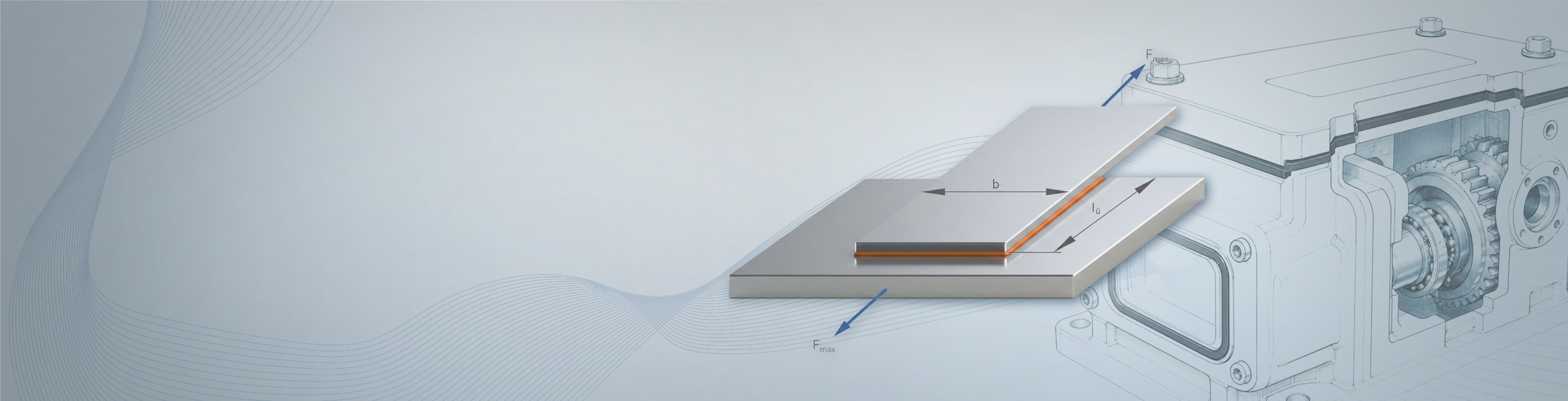
Adhesive joints for engineers
with higher standards
Knowing how much an bonded joints can actually carry
Adhesive bonds enable uniform force transmission without affecting components through drilling, welding heat, or additional fasteners. This opens up design possibilities, particularly for thin-walled components and different materials.
MDESIGN calculates adhesive joints subjected to tensile, shear, and torsional stresses and shows the required bonded area, the load that can be transmitted, and the level of safety provided. This allows existing joints to be verified and new adhesive joints to be specifically designed.
Establish standards, accelerate engineering
MDESIGN provides a consistent basis for calculations across the entire team. Structured data entry, centrally maintained calculation bases, and consistent documentation ensure that results remain traceable and comparable across projects.
For over 40 years, MDESIGN has been helping companies calculate and design technical components—today with more than 35,000 users worldwide.
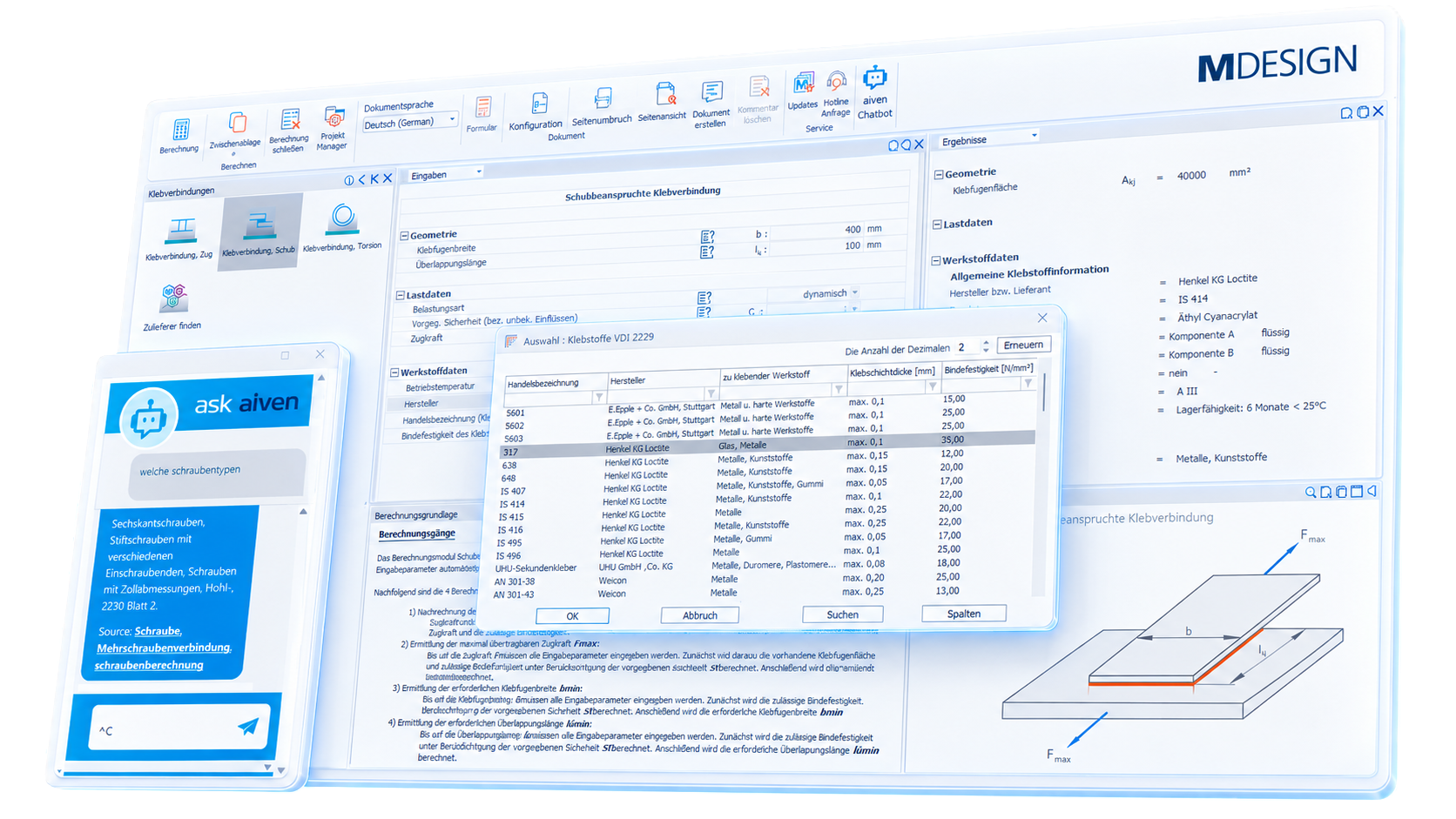
Directly determine the bonding area, load capacity, and dimensions
Depending on the joint, different forces act on the adhesive layer. Tension, shear, and torsion each place their own demands on the geometry, the bonded joint area, and the adhesive. MDESIGN combines these influencing factors in its calculations and uses them to determine, among other things, the required overlaps, bonded joint widths, component dimensions, and maximum transferable loads. This transforms an initial connection concept into a concrete design that can be technically evaluated and specifically adapted.
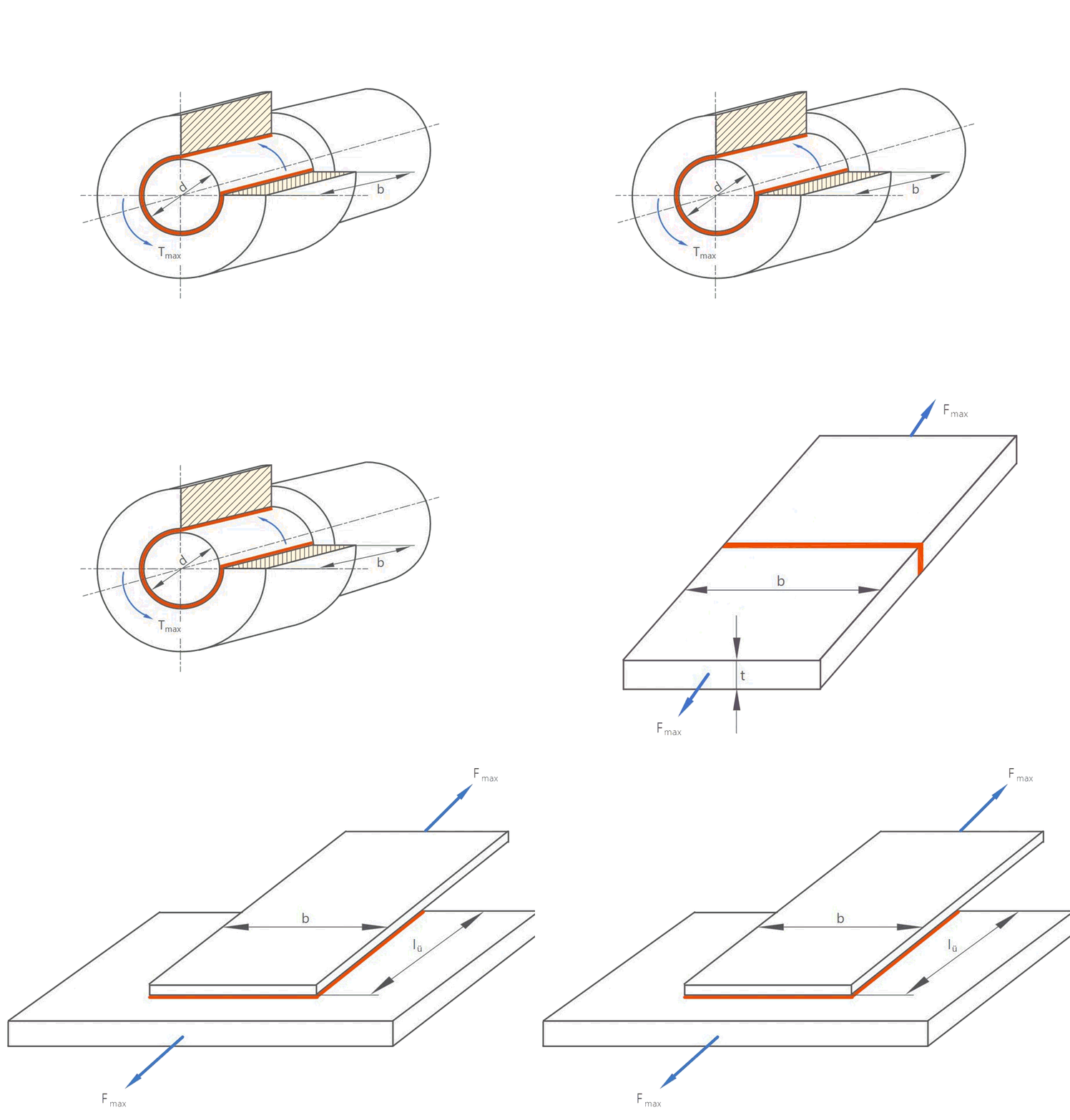
Designing adhesive joints for different load cases
Not every bonded joints is subjected to the same load. MDESIGN therefore distinguishes between typical load cases and adapts the calculation to the specific connection situation.
MDESIGN checks the existing joint or determines the required adhesive joint width, the necessary component thickness, and the maximum transferable tensile force.
The following are taken into account- available tractive force
- Adhesive Joint Width
- Component thickness
- Adhesive joint area
- Bond Strength of the Adhesive
- desired safety factor
- static or dynamic load
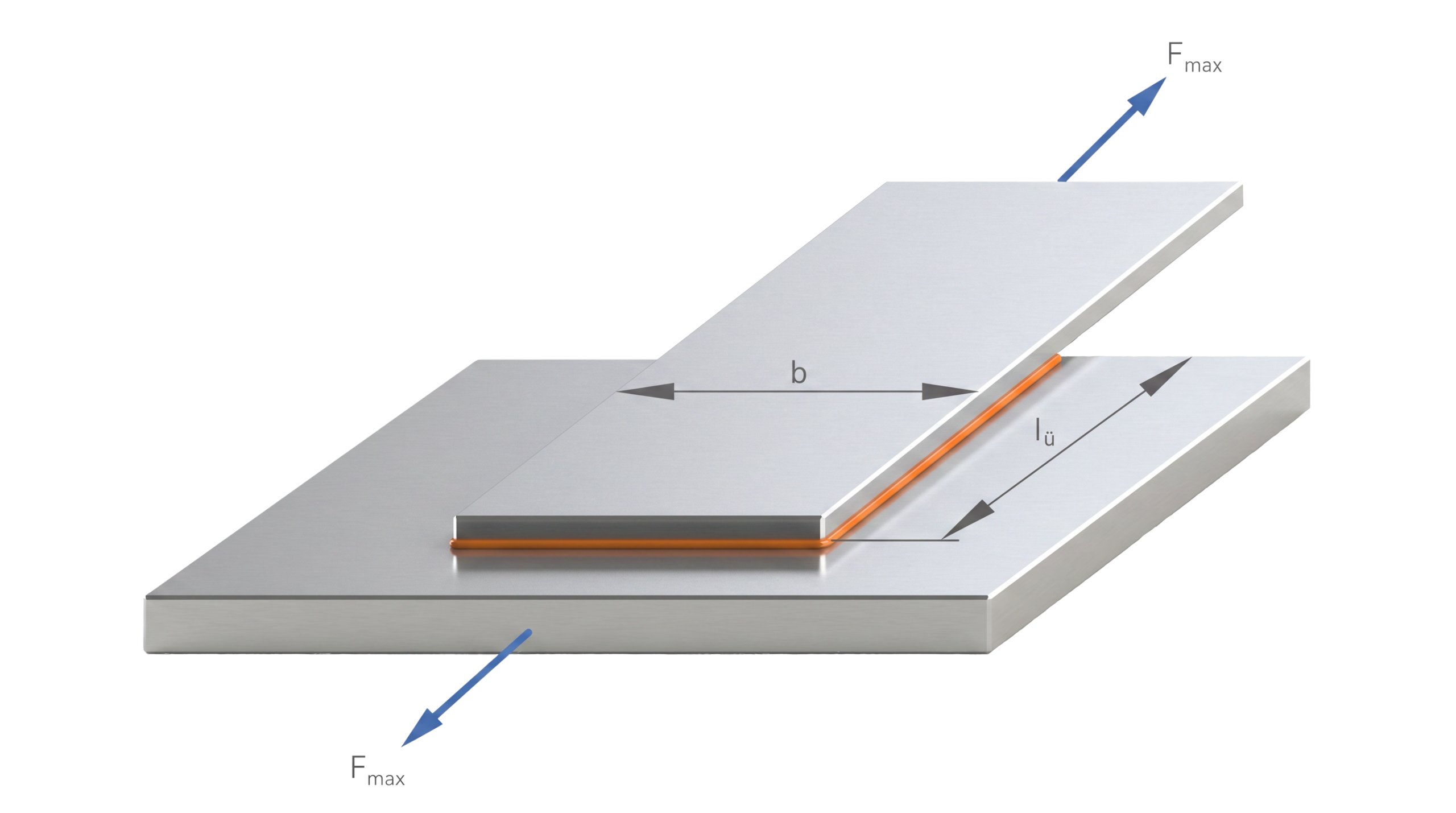
MDESIGN calculates whether the existing overlap is sufficient or what minimum width or overlap length is required.
The following are calculated:- maximum transmissible force
- Required adhesive joint width
- required overlap length
- effective bonded joint area
- permissible bond strength
- Connection Security
MDESIGN evaluates the adhesive joint under the applied torque and determines the required geometry of the joint.
The following are calculated:- maximum transmissible torsional moment
- Required adhesive joint width
- required shaft diameter
- cylindrical bonded joint surface
- permissible bond strength
- Protection Against Overuse
Include the cost of the appropriate adhesive in the calculation
The performance of a bonded joints depends largely on the adhesive used. That is why MDESIGN provides more than 220 adhesives from various manufacturers directly for use in calculations. The stored properties can be applied without manual entry and immediately linked to the geometry, load case, and temperature. This allows different adhesives to be compared more quickly and evaluated directly in the specific calculation scenario.
From the adhesive straight to a high-strength design
Once the manufacturer and adhesive have been selected, MDESIGN automatically incorporates the stored bond strengths into the calculation. The permissible load is then determined based on the specified safety factor.
For dynamic loads, a correspondingly reduced bond strength is assumed. This ensures that the actual properties of the selected adhesive are directly factored into the design calculations.
Go directly to the desired provider in the database.
Choose the right adhesive for the material and the joint.
Transfer the stored values to the calculation with a single click.
Metals and hard materials, glass, plastics, fiberglass, GRP, CFRP, fiber-reinforced composites, ceramics, stone, wood, rubber, plastomers, duromers, and many other materials.
Evaluate adhesive joints even under varying loads
A bonded joint may be adequately dimensioned for static loads but may be subjected to significantly greater stress under cyclic loading. In addition, the operating temperature can affect the adhesive's usable strength.
MDESIGN therefore directly incorporates static and dynamic loads, as well as the effect of temperature, into the calculation. For dynamic loading, the reduced bond strength of the selected adhesive is used.
This makes it possible to assess whether the bonding surface, the adhesive, and the geometry are compatible with one another even under the intended operating conditions.
Deriving better adhesive bonds from calculation results
MDESIGN provides a structured comparison of transferable loads, required dimensions, bond strengths, and existing safeties. This quickly reveals which factor determines the design and where adjustments are advisable.
Design engineers can use these results to make specific decisions: increase or decrease bonding areas, adjust overlaps, select a different adhesive, or compare different joining concepts. In this way, the calculation not only supports the verification process but also enables a more targeted and efficient design.
01
Automatically generated charts
Graphical representations of tension, shear, and torsion help users quickly understand connections and force transmission. This makes it immediately clear during the development phase which calculation scenario corresponds to the respective Design .
|
02
Intuitively find the right one Bonded joints
The clearly organized interface, intuitive input options, help features, and built-in fundamentals make it easy to get started. AI assistance provides design engineers with support throughout the work process—even when weld verification isn't part of their daily responsibilities.
|
Documentation and proof at the touch of a button
Automatically generate technical documentation.
All input data, standards, boundary conditions, results, and graphics are automatically compiled into a complete set of documentation. This results in transparent verification documentation for internal development, customers, testing organizations, or manufacture.
Features of the MDESIGN adhesive bond calculation
The calculation methods are categorized by tensile, shear, and torsional stresses. Input data and results are compared only within the actual calculation steps.
-
Basis for calculation
The modules support the calculation of adhesive bonds for various material combinations and operating temperatures.
- VDI 2229
- Calculation based on the literature
- Static load
- Dynamic loading
- Similar and different materials
- Operating temperatures from −25 °C to +155 °C
-
Tensile-loaded adhesive joints
Depending on the specifications, the connection is either inspected or designed to meet the required dimensions or the maximum transmissible tensile force.
Check the connection
Verification of the existing Bonded joints under tensile load.
Input values
- Adhesive Joint Width
- Component thickness
- Traction
- Type of load
- Prescribed Safety
- Operating temperature
- Adhesive and Bond Strength
Calculated Results
- Adhesive joint area
- Maximum Transmissible Tractive Force
- Static bond strength
- Dynamic bond strength
- Permissible Bond Strength
- Existing security
Size the connection
Determining missing dimensions based on load, material, and safety.
Input values
- Traction
- Existing adhesive joint width or component thickness
- Type of load
- Prescribed Safety
- Operating temperature
- Adhesive Properties
Calculated Results
- Minimum required adhesive joint width
- Minimum required component thickness
- Maximum Transmissible Tractive Force
- Required adhesive joint area
-
Shear-loaded adhesive joints
The joint is defined by the width of the adhesive joint and the overlap length, and is evaluated in terms of load-bearing capacity and safety.
Check the connection
Evidence of existing overlap bonding.
Input values
- Adhesive Joint Width
- Overlap Length
- Traction
- Type of load
- Prescribed Safety
- Operating temperature
- Adhesive and Bond Strength
Calculated Results
- Adhesive joint area
- Maximum Transmissible Tractive Force
- Static bond strength
- Dynamic bond strength
- Permissible Bond Strength
- Existing security
Size the connection
Determining the required bonding geometry.
Input values
- Traction
- Existing adhesive joint width or overlap length
- Type of load
- Prescribed Safety
- Operating temperature
- Adhesive Properties
Calculated Results
- Minimum required adhesive joint width
- Minimum required overlap length
- Maximum Transmissible Tractive Force
- Required adhesive joint area
-
Torsional-loaded adhesive joints
Cylindrical adhesive joints are defined by the shaft diameter and the width of the adhesive joint and are rated for the transferable torsional moment.
Check the connection
Proof of an existing cylindrical Bonded joints.
Input values
- Adhesive Joint Width
- Shaft diameter
- Torsional moment
- Type of load
- Prescribed Safety
- Operating temperature
- Adhesive and Bond Strength
Calculated Results
- Adhesive joint area
- Maximum Transmissible Torsional Moment
- Static bond strength
- Dynamic bond strength
- Permissible Bond Strength
- Existing security
Size the connection
Determination of the required cylindrical bonding geometry.
Input values
- Torsional moment
- Existing adhesive joint width or shaft diameter
- Type of load
- Prescribed Safety
- Operating temperature
- Adhesive Properties
Calculated Results
- Minimum required adhesive joint width
- Minimum required shaft diameter
- Maximum Transmissible Torsional Moment
- Required adhesive joint area
-
Adhesives & specifications
The integrated database provides the adhesive information needed for calculation and processing.
- Integrated adhesive database with more than 220 adhesives
- Manufacturer and Trade Name
- Chemical Basis
- Static bond strength
- Dynamic bond strength
- Permissible Bond Strength
- Operating temperature
- Preferred Material Combinations
- Adhesive layer thickness
- Pot life and flash-off time
- Time to Initial and Final Strength
- Adhesive Consumption and Curing Conditions
-
Materials & temperature
The joint can be evaluated for both identical and dissimilar materials, as well as for metallic and non-metallic components.
- Metal-Metal Bonds
- Metal-Plastic Joints
- Different Material Combinations
- Temperature range from −25 °C to +155 °C
- Temperature-Dependent Bond Strength
- Selecting Adhesives Based on Material Properties
-
Results & analyses
The calculation provides a concise summary of the results relevant to the technical evaluation.
- Adhesive joint area
- Maximum Transmissible Tractive Force
- Maximum Transmissible Torsional Moment
- Minimum required adhesive joint width
- Minimum required component thickness
- Minimum required overlap length
- Minimum required shaft diameter
- Static and dynamic bond strength
- Permissible Bond Strength
- Existing security
- Evaluation of the connection
Try it for free – Your access to MDESIGN
Discover for free
Learn about the features
Just get started
No download, no installation
Full range of services
14 days of access to all sections