
Rolling bearing calculation for
future-proof designs
Roller bearings design to match the load, speed, and service life
Roller bearings are among the key mechanical components of modern drive systems. They transmit forces, guide shafts, and have a significant impact on the service life, smoothness of operation, and operational reliability of a design. Which design is suitable therefore depends not only on the load, but also on speed, installation space, lubrication, and operating conditions.
MDESIGN can be used to design, verify, and document roller bearings. Advanced, standard-compliant methods also enable the evaluation of load distributions and reference service lives. This provides a solid foundation for bearing selection, design, and technical verification.
Standards and guidelines considered for Roller Bearings
Static Load-Bearing Capacity
DIN ISO 76
Shelf life
DIN ISO 281
Extended service life
DIN 26281 & ISO 16281
Lubricant viscosity
DIN ISO 3448
Establish standards, accelerate engineering
MDESIGN provides a consistent basis for calculations across the entire team. Structured data entry, centrally maintained calculation bases, and consistent documentation ensure that results remain traceable and comparable across projects.
For over 40 years, MDESIGN has been helping companies calculate and design technical components—today with more than 35,000 users worldwide.
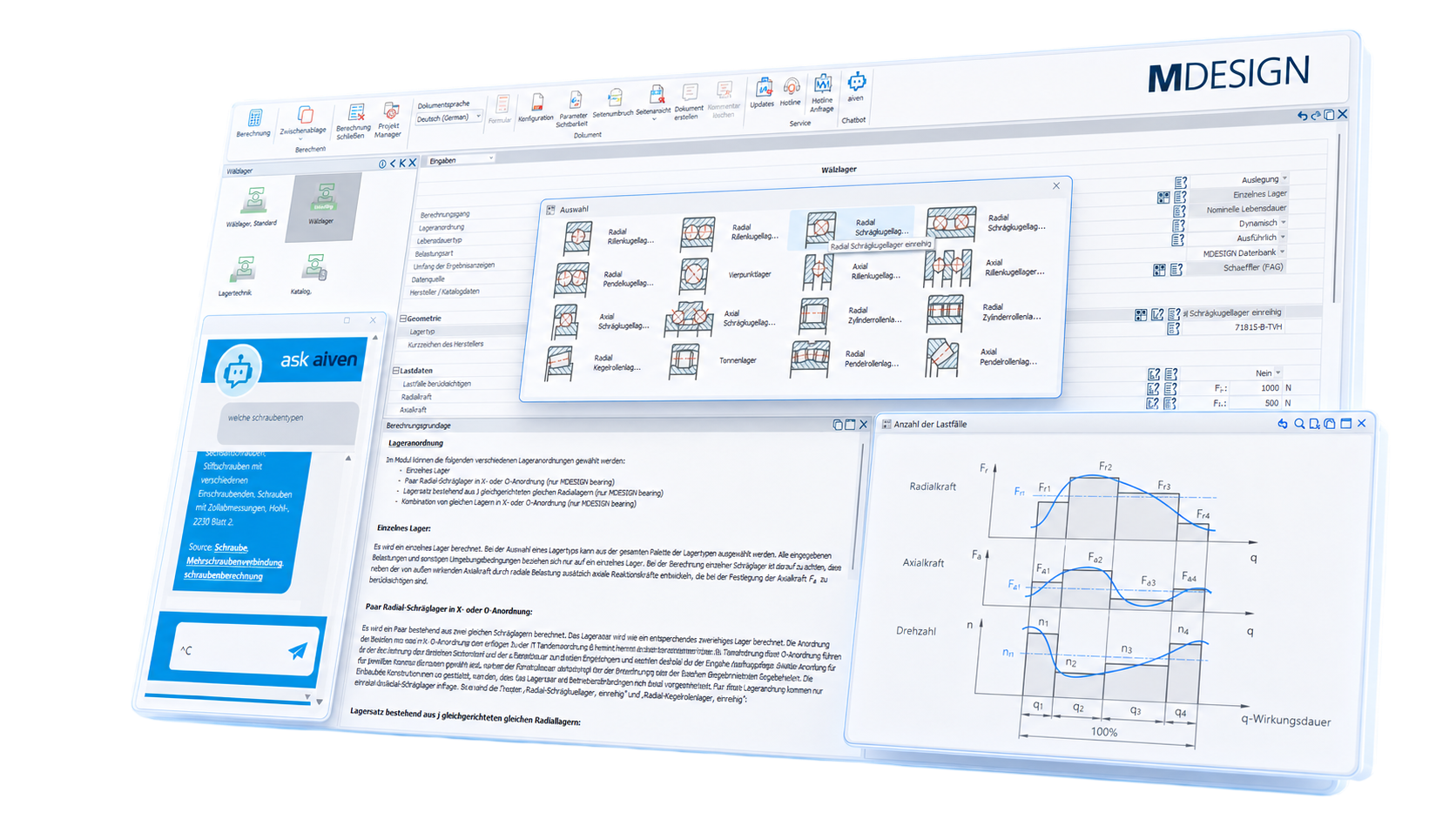
Determining the load capacity and service life of a bearing assembly
For the design, the load and the bearing capacity must be matched. Radial and axial forces, rotational speed, load ratings, and desired service life are the key parameters for this. Calculations include static safety, equivalent loads, nominal and extended service life, as well as limit and average speeds. Friction torque, friction power, operating temperature, and lubrication conditions round out the evaluation. This allows one to verify whether a selected bearing is suitable for the intended application or whether a different size, bearing type, or arrangement is required.
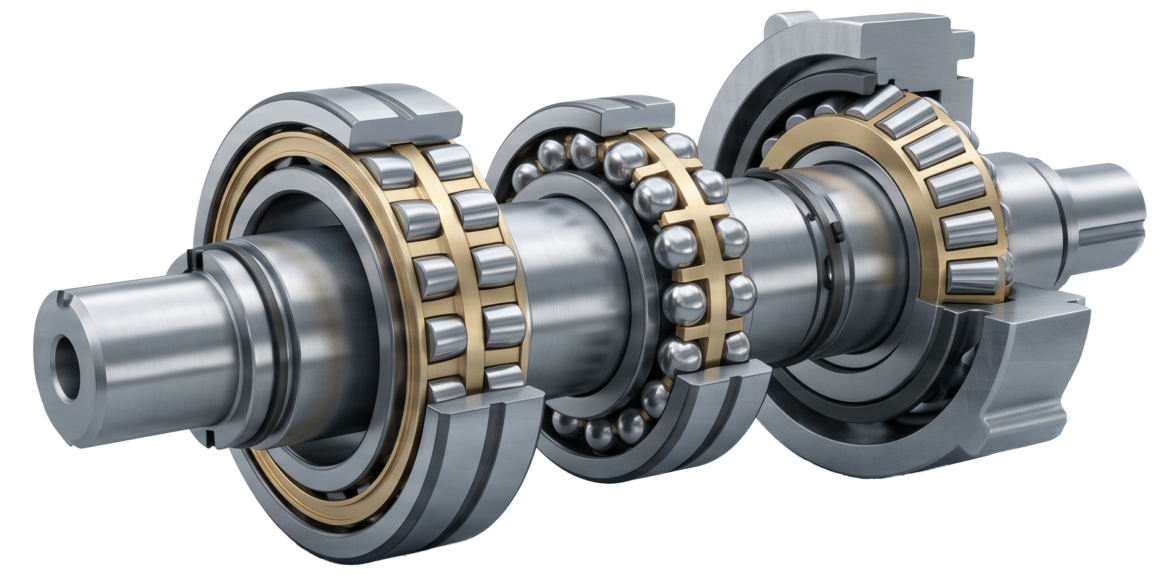
Use inventory data from leading manufacturers
The integrated bearing databases enable the quick selection of suitable roller bearings from various manufacturers. In addition, users can supplement their own bearing data and manage it according to their company’s specific needs. Based on load, desired service life, and available installation space, a suitable catalog bearing can be selected and then further evaluated.
Roller bearings for various installation scenarios
Depending on the force distribution and installation conditions, different bearing types may be suitable. Radial, axial, or combined loads each place different demands on bearing geometry and arrangement.
The scope of calculations ranges from ball and roller bearings to bearing pairs and bearing assemblies. Angular contact bearings, for example, can also be analyzed in X, O, or tandem configurations.
This makes it possible to model both individual bearing assemblies and more complex combinations within the same calculation environment.
Consider lubrication, friction, and operating temperature
The achievable bearing service life does not depend solely on load and load rating. Viscosity, contamination, type of lubrication, and temperature affect the conditions at the contact point between the rolling elements and the raceway.
Factors such as viscosity class, ambient temperature, oil purity, and type of lubrication can be taken into account in the evaluation. This determines the operating temperature, friction torque, friction power, and the viscosity of the lubricant during operation.
This allows the bearing to be evaluated more closely in relation to its actual operating conditions and determines whether the selected lubrication conditions are appropriate for the desired service life.
Quickly understand and evaluate results
|
01
Guided interface and results overview
Structured input fields, help texts, and technical notes assist in selecting the installation position, rotational speed, service life, and lubrication. An AI assistant helps answer questions that arise during the calculation process. Key parameters and results are then clearly presented.
|
02
Understanding bearing locations in a 3D model
Diagrams and technical graphics illustrate service life, loads, and other calculated parameters. They help users grasp relationships more quickly and better interpret results.
|
Documentation and proof at the touch of a button
Automatically generate technical documentation.
All input data, standards, boundary conditions, results, and graphics are automatically compiled into a complete set of documentation. This results in transparent verification documentation for internal development, customers, testing organizations, or manufacture.
Features of the MDESIGN rolling element bearing calculation tool
The functions are organized into compact sections based on standards, bearing types, bearing arrangements, design, verification, service life, lubrication, load distribution, and manufacturer data.
-
Standards & calculation bases
- DIN ISO 76
- DIN ISO 281
- DIN 26281
- ISO/TS 16281
- DIN ISO 3448
- Calculation based on the literature
-
Bearing types
- Radial deep-groove ball bearings, single-row and double-row
- Radial angular contact ball bearings, single-row and double-row
- Radial-thrust ball bearings, double-row
- Four-point bearing
- Axial deep-groove ball bearings, single- and double-acting
- Axial angular contact ball bearings, single-direction and double-direction
- Radial cylindrical roller bearings, single-row, double-row, and four-row
- Radial tapered roller bearings, single-row, double-row, and four-row
- Spherical roller bearing
- Radial-spherical roller bearings, double-row
- Toroidal roller bearings
- Axial cylindrical roller bearings, single- and double-acting
- Single-row axial self-aligning roller bearings
- Radial needle roller bearings, single-row and double-row
- Axial Needle Bearings
-
Bearing arrangements & bearing combinations
- Single bearing
- Pair of radial-angular contact bearings in an X or O configuration
- Bearing set consisting of identical, aligned bearings
- Combination of identical bearings in an X or O configuration
- Tandem configuration
- Angular contact bearing combination consisting of two partial bearing sets
- Internal Axial Forces
- Total service life of the combination
-
Design & bearing selection
Input values
- Bearing type
- External form
- Radial force
- Axial force
- Rotational speed
- Expected service life
- Required reliability
- Required: safety against static loads
- Min. allowable shaft diameter
- Max. allowable outer diameter
- Max. permissible bearing width
- ISO viscosity class
Output values
- Short name of the warehouse
- Bearing series
- Nominal diameter of the bearing bore
- Nominal diameter of the bearing shell
- Nominal width
- Static load capacity
- Dynamic load capacity
- Maximum speed
- Structural safety
- Rated service life
Sample results chart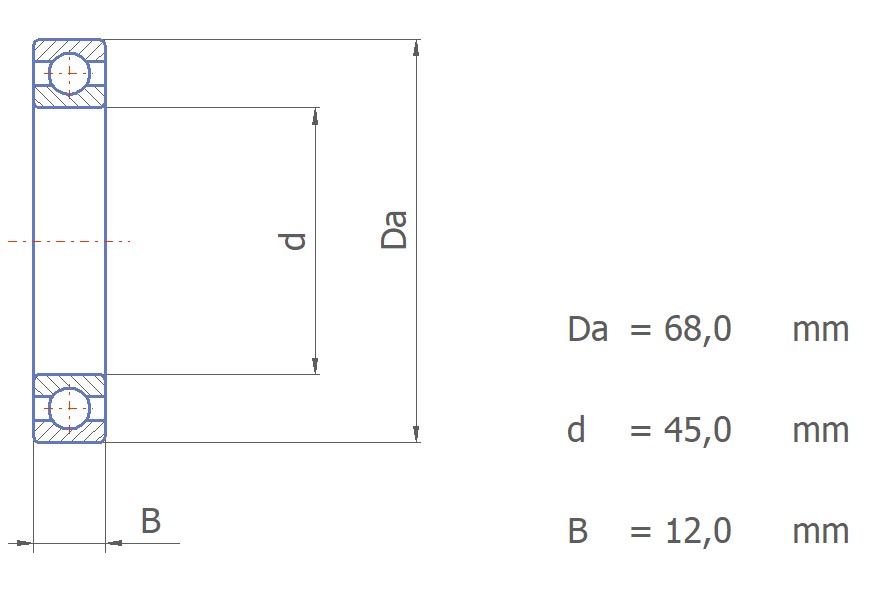
An illustrative graphical analysis of the single-row radial deep-groove ball bearing. -
Billing & load data
Input values
- Radial force
- Axial force
- Rotational speed
- Duration of effect
- Take load cases into account
- Rapid load cycling
- Static load capacity
- Dynamic load capacity
- Fatigue limit load
- Dynamic radial factor
- Dynamic axial factor
Output values
- Equivalent static load
- Structural safety
- Equivalent dynamic load
- Average equivalent dynamic load
- Medium speed
- Rated service life
- Extended service life
- Evaluation of the results
-
Service life calculation
Input values
- Lifespan type
- Expected service life
- Required reliability
- Required: safety against static loads
- Contamination factor
- ISO viscosity class
- Ambient temperature
- Lubrication method
Output values
- Rated service life
- Extended service life
- Nominal reference service life
- Modified reference service life
- Service life factor for reliability
- Service life factor, based on a system-level approach to service life calculation
- Structural safety
-
Lubrication, friction, and temperature
Input values
- ISO viscosity class
- Ambient temperature
- Oil Flow in Circulating Lubrication Systems
- Oil Inlet Temperature
- Cooling factor
- Contamination factor
- Lubrication method
- Cleanliness / Oil Purity Class
Output values
- Operating temperature
- Kinetic viscosity at operating temperature
- Frictional torque of the bearing
- Friction power
- Cooling capacity of circulating lubrication
- Heat convection to the environment
- Maximum frictional torque of the bearing
- Max. friction power
-
Load distribution in accordance with DIN 26281
Input values
- Radial force
- Axial force
- Moment load
- Radial operating clearance of the bearing
- Relative axial displacement of the two bearing rings
- Relative radial displacement of the two bearing rings
- Angle of misalignment between the inner ring and the outer ring
- Rated contact angle of the bearing
Output values
- Load on the rolling element
- Operating contact angle of the rolling element
- Spring-loaded rolling element
- Dynamic load capacity of the single contact on the inner ring
- Dynamic load capacity of the single contact on the outer ring
- Dynamically equivalent reference load
- Nominal reference service life
- Modified reference service life
-
Manufacturer & catalog information
- IBC Manufacturer Inventory Data
- KRW Manufacturer Inventory Data
- SBN Manufacturer Inventory Data
- Schaeffler (FAG and INA) Manufacturer Bearing Data
- SKF Manufacturer Bearing Data
- Timken Manufacturer Bearing Data
Try it for free – Your access to MDESIGN
Discover for free
Learn about the features
Just get started
No download, no installation
Full range of services
14 days of access to all sections